
 English
  한국어
한국어
What’s the Difference Between BM25 and RAG?
Information retrieval is an essential technology in today’s digital age. Search engines like Google constantly evolve to find and rank the most relevant documents for user queries. In this process, BM25 (Best Matching 25) has long played a crucial role. However, BM25 is not perfect, and recently, new approaches like RAG (Retrieval-Augmented Generation) are emerging, changing the information retrieval paradigm. This article will compare the workings of BM25 and RAG, examine the strengths and weaknesses of each method, and explore how they can be used together in production systems to increase productivity. Understanding the limitations of BM25 and the strengths of RAG will help you build an effective information retrieval strategy.
In the past, information retrieval was sufficient to simply determine whether keywords matched. However, user intent can be more complex than keywords, and searches that do not consider context and meaning may not provide accurate results. RAG, which has emerged to solve this problem, allows for semantic search unlike BM25, and can provide more relevant information by more accurately understanding user intent. While BM25 still plays an important role, it can achieve a more powerful synergistic effect when used with RAG.
BM25: The Classic of Keyword Matching
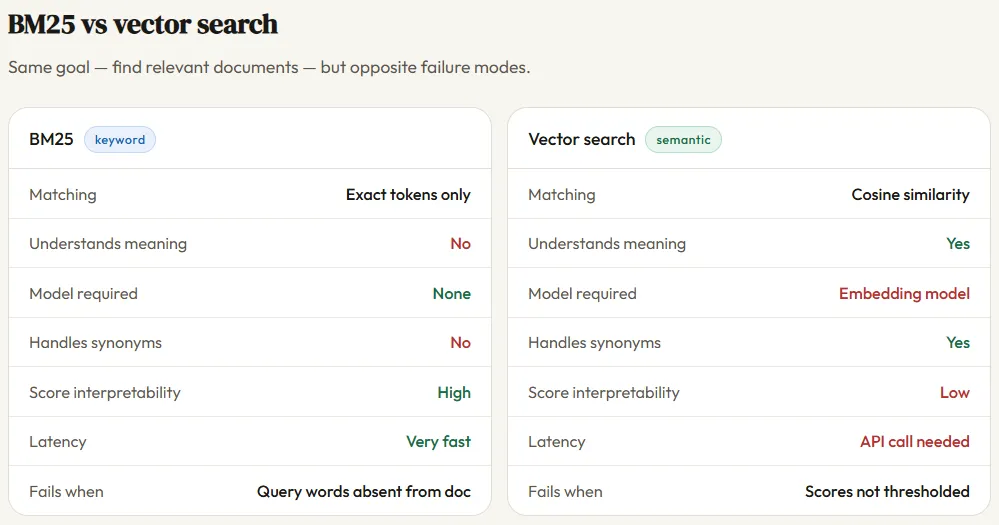
BM25 is a core algorithm for search engines such as Elasticsearch and Lucene. BM25 scores the relevance of documents by considering the frequency of keywords in the document, the rarity of keywords, and the length of the document. A key advantage of BM25 is its ability to prevent keyword stuffing. It applies a saturation mechanism to effectively suppress keyword abuse, preventing the relevance of a document from increasing 20 times just by repeating keywords 20 times. However, BM25 has the limitation of relying only on exact keyword matching and failing to understand user intent or context. For example, searching for ‘heart attack’ might not find documents with semantically similar terms like ‘heart failure.’
Detailed Analysis of BM25’s Operation
- Term Frequency (TF): Measures the frequency of keywords in a document. However, instead of simple frequency calculation, a saturation mechanism is applied to reduce the increase in score as the frequency increases.
- Inverse Document Frequency (IDF): Measures the rarity of keywords. It assigns higher weights to rarer words like ‘retrieval’ than common words like ‘the’.
- Length Normalization: Corrects for the length of the document. Long documents are more likely to contain more keywords, so the score is adjusted based on document length.
RAG: An Innovation in Semantic Search
RAG is a new approach that has emerged to overcome the limitations of BM25. RAG uses an embedding model to convert both queries and documents into vectors and calculates cosine similarity to find semantically similar documents. This allows searching for documents with similar meanings that BM25 cannot find. For example, searching for ‘heart attack’ can find documents with different keywords but related meanings, such as ‘heart failure’. However, RAG requires an embedding model and API calls, making it slower and more expensive than BM25.
Detailed Analysis of RAG’s Operation
- Embedding Generation: Converts queries and documents into vectors using an embedding model.
- Cosine Similarity Calculation: Calculates the cosine similarity between the query vector and the document vector. Cosine similarity ranges from 0 to 1, with values closer to 1 indicating greater semantic similarity.
- Ranking: Ranks documents based on the cosine similarity score.
BM25 vs. RAG: Comparative Analysis with Python
To clearly understand the difference between BM25 and RAG, we conducted a comparative analysis using Python code. First, we install the necessary libraries, define a corpus, build a BM25 index, and build an embedding retriever. Then, we run BM25 and RAG using the same query and compare the results. This demonstrates that BM25 excels in keyword-based search, while RAG excels in semantic search. BM25 is fast and lightweight, while RAG provides more accurate search results. Therefore, a hybrid search that combines both technologies is the optimal solution.
Industry Impact and Future Prospects
The emergence and development of BM25 and RAG are accelerating innovation in information retrieval technology. While BM25 is still widely used in many search engines, its role is expected to gradually diminish due to the introduction of new technologies such as RAG. In the future, hybrid search that combines BM25 and RAG will become more prevalent, and continued research and development will be conducted to more accurately understand user intent and provide relevant information. In addition, these technologies are expected to be used in various fields such as search engines, chatbots, recommendation systems, and knowledge management systems. Understanding the basic principles of BM25 and leveraging the strengths of RAG will be an important task for the future.
In conclusion, BM25 is a powerful tool for keyword-based search, but RAG presents new possibilities for semantic search. By combining the two technologies appropriately, you can maximize the accuracy and efficiency of information retrieval, which will lead to innovation across various industries. The development of BM25 and RAG will continue, and we must learn and apply new technologies to keep pace with these changes.
In-depth Analysis and Implications
Array