
 English
  한국어
한국어
Introduction: The Potential of Personal AI Beyond Cloud Dependency
As artificial intelligence technology advances, interest is growing in building AI agents for individual users. Most existing AI agents tend to heavily rely on cloud-based APIs. This presents limitations in various aspects such as data security, response speed, and cost. Particularly for agents handling sensitive data such as personal files, messages, and usage history, cloud dependency can pose serious problems. To address these issues and maximize the potential of personal AI agents, the Stanford research team has released OpenJarvis, an innovative open-source framework.
OpenJarvis is designed to build and run personal AI agents in an on-device environment. This aims to enhance data security by performing all operations locally, reduce response times, and save costs associated with cloud usage. Furthermore, OpenJarvis supports the integration of diverse models and tools, enabling the development of more powerful and flexible agents. This article will examine the key features and characteristics of OpenJarvis and analyze its impact and future prospects on the personal AI field.
Main Body: Core Features and Structure of OpenJarvis
1. Five Core Primitive Architectures: Design for Flexibility and Extensibility
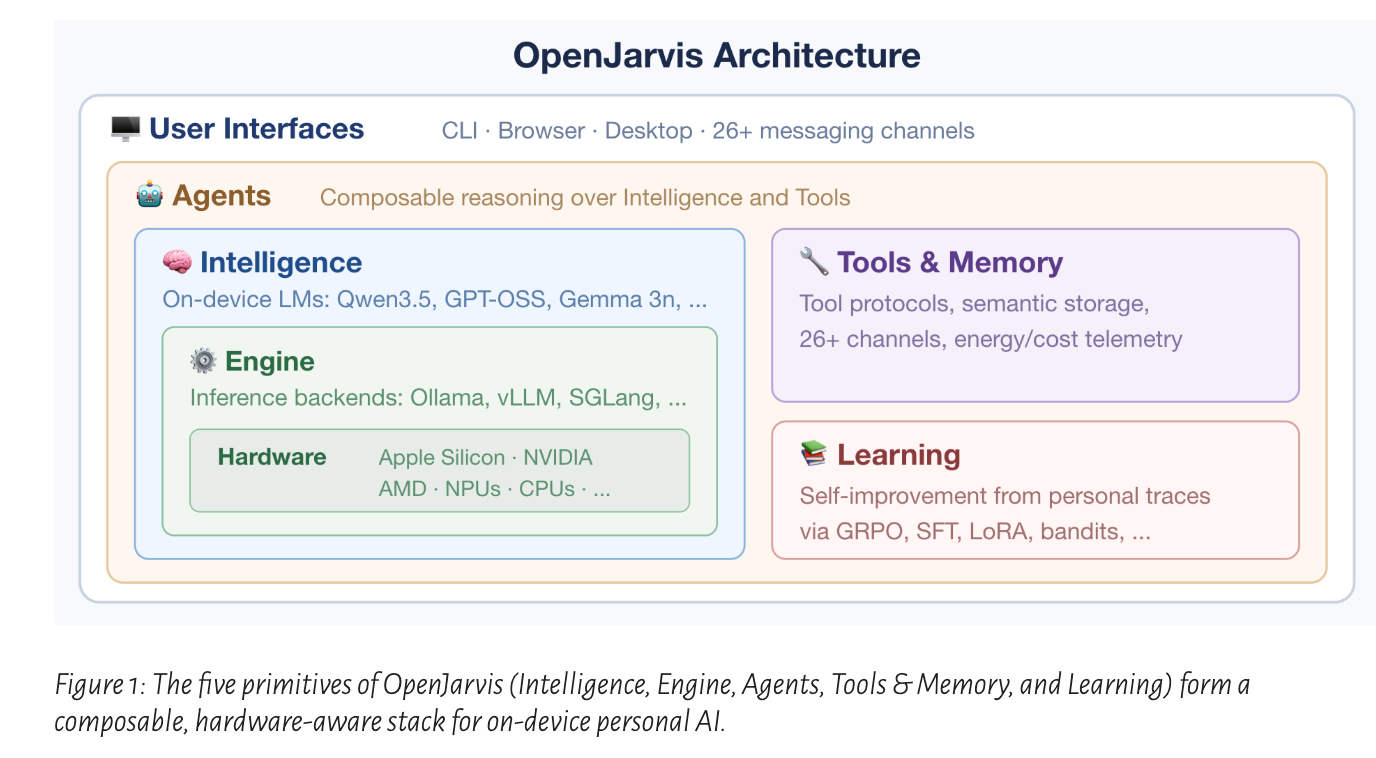
OpenJarvis adopts a unique architecture composed of five Primitives: Intelligence, Engine, Agents, Tools & Memory, and Learning. Each Primitive can be benchmarked, replaced, and optimized independently, or used as an integrated system. This design enables modular development, clarifies the role of each component, and improves maintainability. In particular, existing local AI projects often mix various functions into a single application, such as inference, orchestration, tool utilization, data retrieval, and adaptive logic. OpenJarvis resolves this issue by separating these layers, facilitating development and testing.
2. Intelligence: Efficient Management of Model Layers
The Intelligence Primitive is responsible for the model layer and provides an integrated catalog of various local model families. This allows developers to focus on model selection without needing to individually track model parameters, hardware compatibility, and memory trade-offs. This is an important factor in increasing the usability of OpenJarvis. The ease of model selection allows for various experiments with OpenJarvis and helps apply optimized models to users.
3. Engine: Inference Runtime Optimized for Hardware
The Engine Primitive provides a common interface for various backends such as Ollama, vLLM, SGLang, llama.cpp, and cloud APIs, acting as an Inference Runtime. OpenJarvis does not enforce a specific runtime and treats inference as a pluggable layer. This provides developers with flexibility and allows them to choose an Inference Runtime optimized for various hardware environments. OpenJarvis also provides functionality to detect available hardware environments and recommend appropriate Engine and model settings, as well as diagnostic features to aid in setting management.
4. Agents: An Active Behavior Layer
The Agents Primitive converts the model’s capabilities into structured behavior under the constraints of the actual device (limited context window, limited working memory, efficiency limitations, etc.). Instead of relying on a single general-purpose agent, OpenJarvis supports configurable roles. For example, an Orchestrator is used to divide complex tasks into subtasks, and an Operative is used to execute repetitive personal workflows. This role-based design further refines and specializes agent functionality, increasing efficiency.
5. Tools & Memory: A Grounding Layer for Expanding Agent Intelligence
The Tools & Memory Primitive provides various functions, including standardized tool usage through the Model Context Protocol (MCP), Google A2A for agent-to-agent communication, semantic indexing for local memory retrieval, and support for various tools such as web search, calculator access, file I/O, code interpretation, and connection to external MCP servers. OpenJarvis aims to provide more than just a local chat interface, but to connect local models with tools and personal contexts to strengthen data security. This Primitive is one of the core functions of OpenJarvis and maximizes the usability of personal AI agents.
6. Learning: Closed-Loop Learning for Continuous Performance Improvement
The Learning Primitive provides a closed-loop improvement path using local interaction traces to train models, improve agent behavior, and optimize model selection. OpenJarvis supports optimization for four layers: model weights, LM prompts, agent logic, and Inference Engine. This continuous learning capability consistently improves the performance of personal AI agents and contributes to providing users with a more satisfying experience. This functionality makes OpenJarvis more than just a framework; it’s a constantly evolving platform.
In-Depth Analysis: The Impact and Future Prospects of OpenJarvis, Changing the Landscape of the Personal AI Market
The release of OpenJarvis is expected to bring revolutionary changes to the personal AI market. It addresses the problems of data security, response speed, and cost that existing cloud-based AI agents have, and helps provide users with safer and more efficient services. In particular, OpenJarvis will promote the development of more creative and innovative personal AI agents by providing developers with powerful and flexible development tools. Furthermore, the open-source nature of OpenJarvis encourages community participation and enables continuous development.
It is expected that various personal AI agents will be utilized in diverse fields based on OpenJarvis in the future. For example, personal assistants, smart home control, healthcare, and education can play important roles in various fields. OpenJarvis will also be able to provide richer and more immersive experiences through integration with new platforms such as the metaverse. OpenJarvis will be an important milestone illuminating the future of personal AI technology.
Conclusion: OpenJarvis Opens the Dawn of the Personal AI Era
The release of OpenJarvis by the Stanford research team is an important contribution to the development of personal AI technology. OpenJarvis provides a local-first approach, a flexible and extensible architecture, and learning functionality for continuous performance improvement. These features open up new possibilities for personal AI agent development and help provide users with safer and more efficient services. We look forward to various personal AI agents developed based on OpenJarvis in the future, enriching our lives.
In-Depth Analysis and Implications
Array