 English
  한국어
한국어
NVIDIA OpenShell: Securely Manage Autonomous AI Agents!
Recently, large language models (LLMs) such as ChatGPT have swept the world, leading to an explosive increase in demand for more advanced AI systems. Especially, autonomous agents offer innovative possibilities in various fields, such as automating tasks, research, and creation, as they can use tools, execute code, and perform various tasks themselves. However, there is a shadow that cannot be separated from this powerful functionality, and that is the security problem!
While standard LLM applications are limited to text-based interactions, autonomous agents need to access shell environments, file systems, and network endpoints. This is like having a supercar but being unable to drive it properly, which can lead to accidents. The ‘black box’ nature of the models is a major concern, as it can lead to unintended command execution or unauthorized data access.
NVIDIA OpenShell: A Game-Changing Solution for Secure Autonomous Agents!
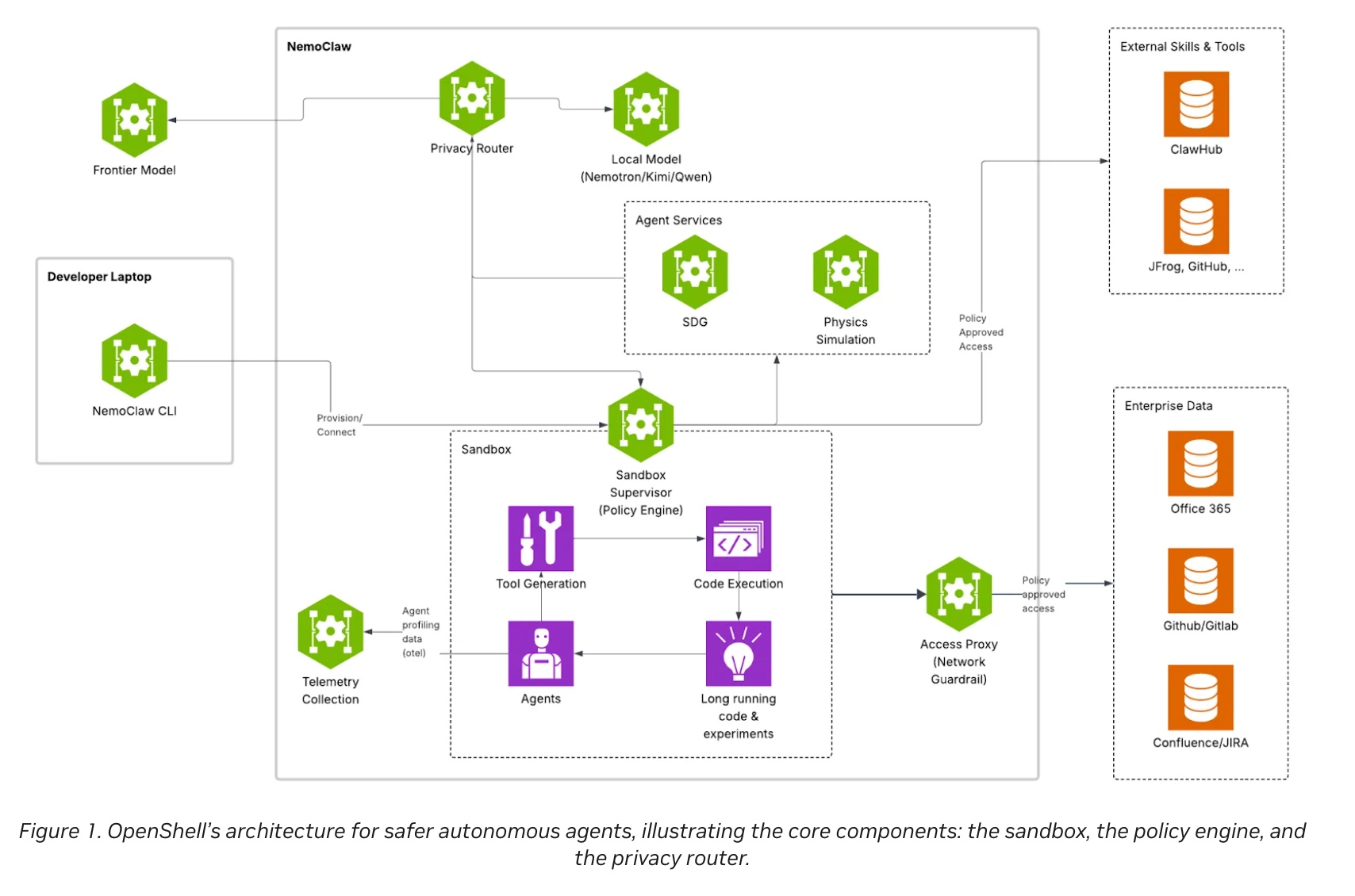
To solve this problem, NVIDIA has prepared a surprising gift! They have released an open-source runtime environment called ‘OpenShell’. Like a seatbelt, OpenShell creates a protective shield between autonomous agents and the operating system, helping AI agents explore the world safely. OpenShell, released under the Apache 2.0 license, provides a framework for sandboxing, access control, and inference management, allowing AI developers to focus on autonomous agent development with peace of mind.
How Does OpenShell Work?
1. Sandbox Environment: Creating a Safe Playground
The core feature of OpenShell is its ability to provide a sandbox environment. Like a playground where children can play safely, all code generated by autonomous agents – Python scripts or shell commands – is executed within a limited space. This prevents autonomous agents from accessing important files or changing system settings, and only allows access when authorized. Like a lifeguard, OpenShell meticulously monitors the actions of autonomous agents.
2. Policy-Based Access Control: Setting Rules and Enforcing Them!
OpenShell performs access control based on a granular policy engine, unlike traditional container security. For example, you can restrict the use of only specific programs (git, curl, python, etc.) or only allow network traffic to specific IP addresses or domains. Furthermore, you can control which APIs or shell functions can be used. All these policies have the advantage of being ‘explainable’, clearly recording which actions are blocked or allowed, and being used for debugging and auditing. Like school rules, OpenShell manages the actions of autonomous agents according to clear rules.
3. Private Inference Routing: Preventing Data Leaks!
OpenShell provides a dedicated layer that intercepts model traffic to apply privacy and cost constraints. This prevents sensitive data from being leaked to external model providers and supports switching between local and cloud-based LLMs without modifying the agent’s core logic. Like a secret passage, OpenShell protects the data of autonomous agents safely.
Freedom to Work with All Autonomous Agents!
A major advantage of OpenShell is that it is not specific to autonomous agents. It provides a consistent security layer, regardless of the architecture used, such as Claude Code, Codex, OpenClaw, or LangChain-based systems. Like Lego blocks, OpenShell can be freely assembled with any autonomous agent.
Convenience for Developers: Leverage CLI and TUI
OpenShell is designed to be easily integrated into existing CI/CD pipelines and local development environments. The command-line interface (CLI) and terminal UI (TUI) allow you to monitor the behavior of autonomous agents in real-time. Like a driving dashboard, OpenShell shows the status of autonomous agents at a glance. In addition, you can perform various tasks, such as creating sandboxes or updating policy files, with simple commands. Like magic, OpenShell improves developer productivity.
A Step Toward the Future: A New Era for Autonomous Agents Begins
With the advent of OpenShell, the development of autonomous agents will advance more safely and reliably. Now, a foundation has been laid to build securely managed autonomous agent systems, moving beyond experimental scripts. NVIDIA will enhance the maturity of autonomous agent technology and drive further innovation through OpenShell. Like space exploration, OpenShell opens the way for the future of autonomous agents.
OpenShell’s Key Highlights
- Apache 2.0 License: Flexible open-source functionality for enterprise and individual users
- Landlock LSM: Kernel-level isolation for robust sandboxing
- L7 Policy Enforcement: Granular control over network and binary execution
- Audit Logging: Complete transparency into agent actions and decisions
- Private Routing: Cost and privacy control for LLM inference traffic
Start developing safe and efficient autonomous agents today with NVIDIA OpenShell!
In-Depth Analysis and Implications
Array
NVIDIA AI Open-Sources ‘OpenShell’: A Secure Runtime Environment for Autonomous AI Agents