 English
  한국어
한국어
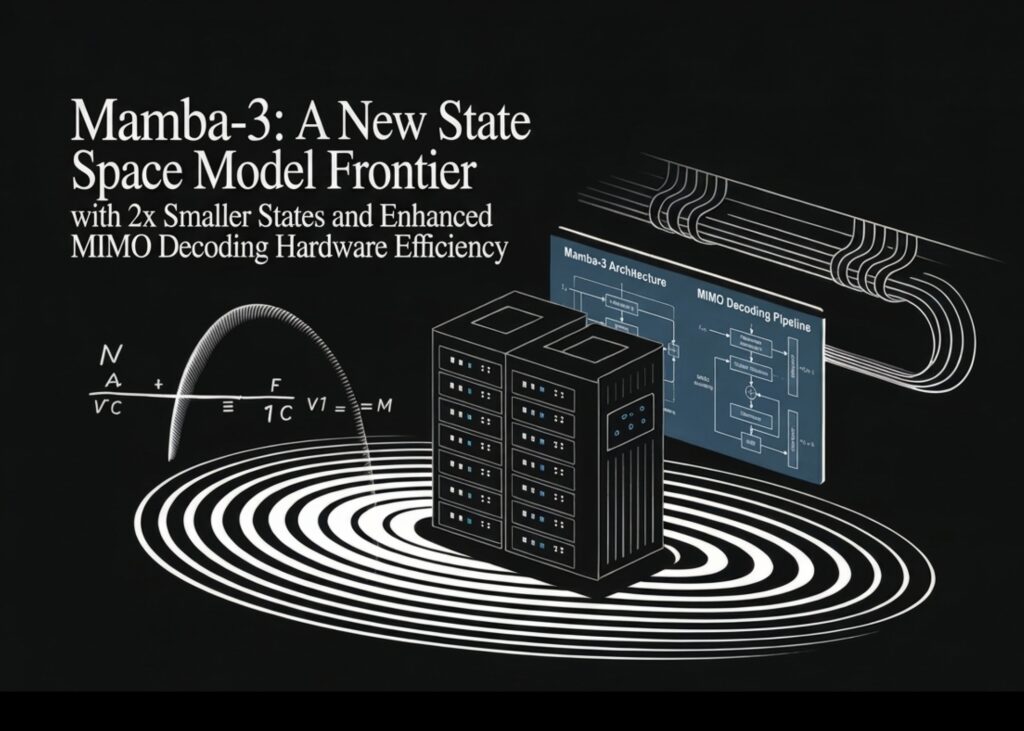
Mamba-3: A New State Space Model Frontier with 2x Smaller States and Enhanced MIMO Decoding Hardware Efficiency
Recently, scaling compute for inference time has emerged as a crucial element for enhancing the performance of large language models (LLMs), leading to increased interest in architectures that consider both model quality and inference efficiency. Traditional transformer-based architectures are still widely used, but their inherent quadratic complexity and linear memory requirements create significant bottlenecks during deployment. To address these issues, a research team from Carnegie Mellon University (CMU), Princeton University, Together AI, and Cartesia AI has announced the Mamba-3 model, leveraging an ‘inference-first’ design to resolve these constraints.
This article provides an in-depth analysis of the key features and technical innovations of the Mamba-3 model, as well as its potential impact and future prospects for the IT industry. Specifically, we will examine closely how Mamba-3 differentiates itself from existing models and what advantages it offers.
1. Mamba-3’s Core Technology: State Space Model (SSM) Based Updates
Mamba-3 is built upon the State Space Model (SSM) framework and incorporates the following three key methodological updates. These updates contribute to overcoming the limitations of existing models and maximizing inference efficiency.
1.1. Exponential-Trapezoidal Discretization
State space models are continuous-time systems and must be discretized to process the discrete sequence being processed. Previous versions such as Mamba-1 and Mamba-2 used a first-order heuristic called ‘exponential-Euler’ discretization. Mamba-3 replaces this with exponential-trapezoidal discretization, providing a second-order approximation of the state-input integration.
Technically, this update changes the recursion from a two-argument update to a three-argument update:
h_{t}=e^{ riangle_{t}A_{t}}h_{t-1}+(1- λ_{t}) riangle_{t}e^{ riangle_{t}A_{t}}B_{t-1}x_{t-1}+ λ_{t} riangle_{t}B_{t}x_{t}This formula is equivalent to applying a data-dependent, width-2 convolution to the state-input Btxt within the core recursion. Empirical tests show that this implicit convolution allows Mamba-3 to operate effectively with taught B and C biases, without the external short causal convolutions typically required in conventional recurrent models. This innovative approach enables more efficient inference with Mamba-3.
1.2. Complex-Valued State Space Models and the ‘RoPE Trick’
A limitation of real-valued linear models is the inability to solve tasks such as ‘state tracking’, such as determining the parity of a bit sequence. This is because the eigenvalues of the transition matrix are constrained to be real, which prevents the representation of the ‘rotational’ dynamics required for such tasks. Mamba-3 integrates complex-valued SSMs to address this issue. The research team has established a theoretical equivalence between discretized complex SSMs and real-valued SSMs using data-dependent Rotary Positional Embeddings (RoPE) on B and C projections.
Using the ‘RoPE trick’, the model applies data-dependent rotations across time steps. This allows Mamba-3 to solve synthetic tasks such as Parity and Modular Arithmetic, which Mamba-2 and real-valued variants cannot perform better than random guessing. This technology is a crucial element that enhances the performance of Mamba-3.
1.3. Multiple Input, Multiple Output (MIMO) Formulation
To address the hardware inefficiency of memory-bound decoding, Mamba-3 has transitioned from a single input single output (SISO) recursion to a multiple input multiple output (MIMO) structure. In standard SSM decoding, the arithmetic intensity is approximately 2.5 ops/byte, which is well below the compute-bound regime of modern GPUs like the H100. MIMO increases decoding FLOPs by up to 4x by transforming the rank R of input and output projections (Bt E RNR and xt E RPR) while keeping the state size constant, changing the state updates from an outer product to a matrix-matrix multiplication. This additional computation overlaps with the existing memory I/O required for state updates, allowing MIMO to improve modeling quality and perplexity while maintaining similar wall-clock decoding latency.
2. Mamba-3’s Architecture and Regularization
The Mamba-3 block follows a Llama-style layout and alternates with SwiGLU blocks. Key improvements include:
- BC/QK Normalization: RMS normalization is applied to B and C projections, mirroring QKNorm in transformers. This stabilizes training and removes the post-gate RMSNorm used in previous versions.
- Head-wise Bias: Taught channel-wise biases are added to the B and C components, inducing convolution-like behavior.
- Hybrid Integration: The addition of a pre-gate group RMSNorm in a hybrid architecture that mixes linear layers and self-attention improves length generalization in retrieval tasks.
3. Results and Efficiency
Evaluations were conducted with four model sizes (180M to 1.5B) on the FineWeb-Edu dataset.
- Downstream Performance: At 1.5B scale, the SISO Mamba-3 variant outperforms Mamba-2 and Gated DeltaNet (GDN). The R=4 MIMO variant improves upon the SISO baseline by an average of 1.2 points.
- Pareto Frontier: Mamba-3 achieves the same pre-training perplexity as Mamba-2 while reducing the state size by half (e.g., a state size of 64 in Mamba-3 matches a state size of 128 in Mamba-2).
- Kernel Performance: Optimized Triton (for pre-pending) and CuTe DSL (for decoding) kernels further lighten the mathematical components. SISO Mamba-3 kernels show lower latency than released Mamba-2 and GDN kernels in a standard BF16 setting.
4. Future Prospects and Impact on the IT Industry that Mamba-3 will Bring
Mamba-3 demonstrates that fundamental perspective shifts in state space models can bridge the gap between theoretical sub-quadratic efficiency and practical modeling capabilities. Mamba-3 can contribute to overcoming the limitations of existing transformer-based models and maximizing inference efficiency, which will play an important role in reducing the deployment costs and increasing accessibility of LLMs. Furthermore, Mamba-3 is expected to stimulate research related to the development of new architectures based on Mamba-3, accelerating innovation in the field of artificial intelligence. In particular, it will open up the possibility of utilizing LLMs in environments with limited resources.
The success of Mamba-3 will induce more research and investment throughout the IT industry, leading to the development of more advanced AI models and technologies. In conclusion, Mamba-3 has set a significant milestone in the field of artificial intelligence and will serve as an important catalyst for future developments.
For more details, please refer to Paper, GitHub Page and Technical details. Also, don’t forget to follow Twitter and join 120k+ ML SubReddit and subscribe to the newsletter. Wait for it! You can also follow us on Telegram.
The post Meet Mamba-3: A New State Space Model Frontier with 2x Smaller States and Enhanced MIMO Decoding Hardware Efficiency appeared first on MarkTechPost.
In-depth Analysis and Implications
Array
Original Source: Meet Mamba-3: A New State Space Model Frontier with 2x Smaller States and Enhanced MIMO Decoding Hardware Efficiency