
 English
  한국어
한국어
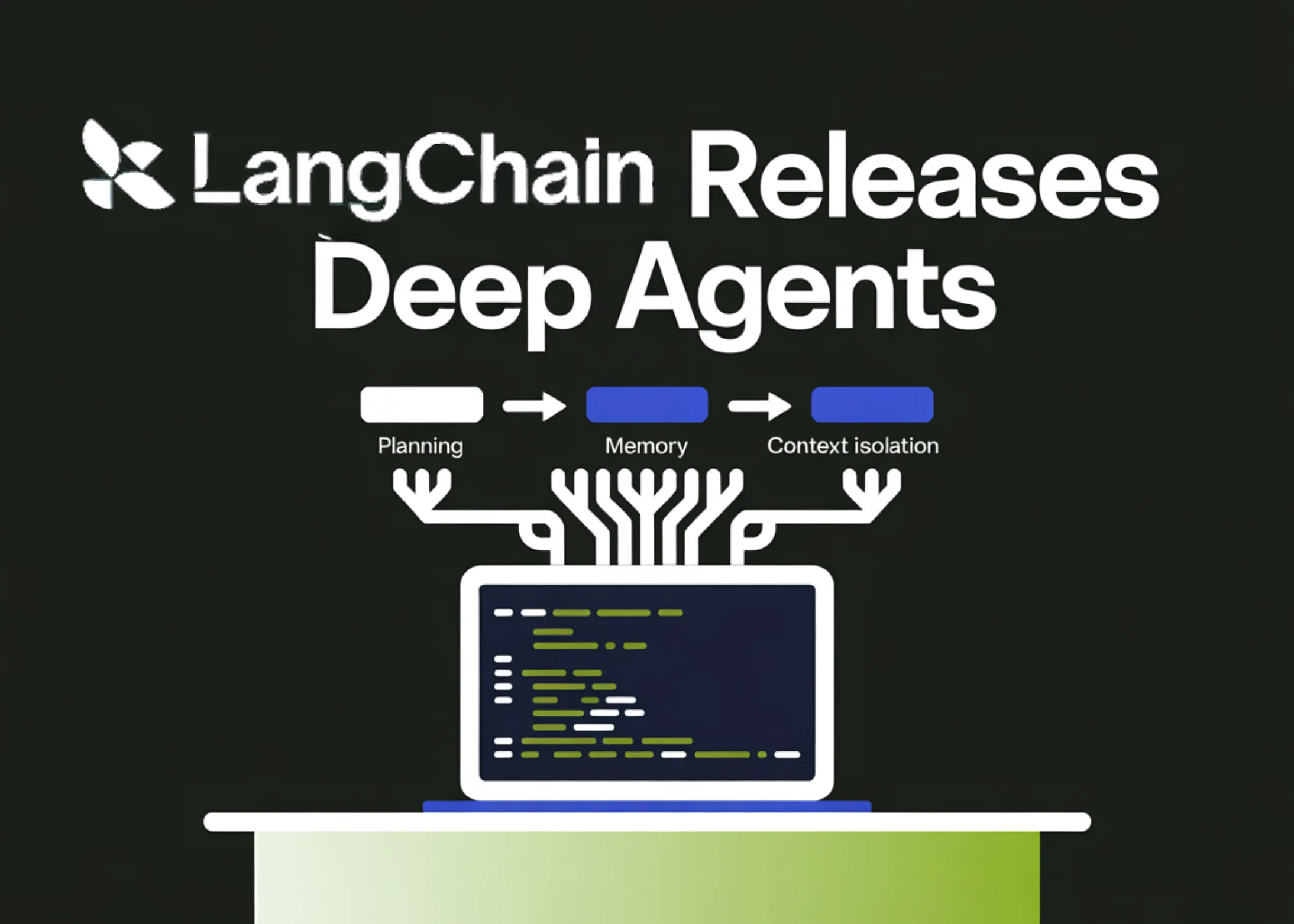
LangChain Deep Agents: Handle Complex AI Tasks with Ease! A Thorough Analysis
As AI agent technology advances, while handling short and simple tasks is straightforward, they often struggle with complex and lengthy tasks. It’s like a chef who can easily make simple toast but encounters difficulties when preparing a multi-course meal. This has been a headache for many developers. LangChain has introduced ‘Deep Agents’ to solve this problem.
Deep Agents are designed to complement the shortcomings of existing LangChain agents and provide more powerful functionality. Just as a skilled chef utilizes new recipes and tools to complete a complex multi-course meal, Deep Agents impart greater ability and efficiency to AI agents. In this article, we will explore the core features and characteristics of Deep Agents and look forward to the impact this technology will have on the AI industry.
What Makes Deep Agents Special?
Deep Agents are not just a collection of tools. Based on LangChain’s agent construction elements, they are referred to as an ‘agent harness’ that supports durable workflows utilizing LangGraph runtime, streaming, and human intervention. It’s like adding excellent design and functionality to an existing garment. Deep Agents maintain the strengths of existing LangChain agents while adding the functionality needed for complex tasks, enhancing usability. Deep Agents packages default settings around a standard tool calling loop instead of introducing new reasoning models or runtimes, making them more accessible to developers.
1. Systematic Planning and Task Decomposition: The write_todos Tool
One of the core functions of Deep Agents is the ability to systematically establish plans and decompose tasks using the ‘write_todos’ tool. This tool supports agents in dividing complex tasks into multiple steps, tracking progress, and updating plans as new information arises. It’s like a project manager dividing a complex project into multiple stages and managing it. Existing models tend to decide on each step spontaneously within the current prompt, but using the ‘write_todos’ tool structures the workflow, making it useful for tasks that require multiple stages such as research, coding, and analysis.
2. Efficient Context Management Based on File System
Deep Agents also provide functionality to manage large-scale contexts using file system tools. This feature prevents context window overflow and supports variable-length tool results. It’s like organizing a large pile of documents to quickly find the necessary information. Agents can save and later retrieve information such as memory, generated code, interim reports, and search results, making them suitable for long-term tasks. Deep Agents support various backend types, including StateBackend, FilesystemBackend, LocalShellBackend, StoreBackend, and CompositeBackend, allowing users to configure flexibly to meet their needs.
3. Context Isolation Using Subagents
Deep Agents can create Subagents to isolate context using the ‘task tool’. It’s like having multiple experts focus on solving problems in their respective fields. When too many goals, tool outputs, and temporary decisions accumulate in a single thread, the model’s quality often degrades. Dividing tasks into Subagents reduces this burden and makes it easier to debug orchestration paths. Deep Agents is another core functionality for efficiently handling complex tasks.
4. Long-Term Memory Function and LangGraph Integration
Deep Agents supports persistent memory functionality between threads by leveraging LangGraph’s Memory Store. It can store and retrieve information from previous conversations, enabling richer and more contextual interactions. Deep Agents operates seamlessly within the LangGraph execution model and supports standard LangGraph features such as streaming, Studio, and checkpointers. Developers can easily integrate and utilize Deep Agents within existing LangGraph environments.
How Will Deep Agents Change the Industry?
The emergence of Deep Agents marks an event that opens a new horizon for AI agent development. Until now, developers had to implement many parts directly to handle complex task processing, but now they can significantly reduce this burden through Deep Agents. In particular, it is expected that Deep Agents will greatly contribute to improving productivity in areas that require complex, multi-stage tasks such as research, coding, and analysis. Deep Agents are also expected to broaden the scope of LangChain agent utilization and accelerate the popularization of AI technology.
In the future, AI agent harnesses like Deep Agents are expected to continue to evolve and provide various specialized functions for specific fields. For example, AI agents that analyze patient medical records and establish optimal treatment plans may appear in the medical field, or AI agents that support investment decisions through market prediction may appear in the financial field. Deep Agents will serve as a foundation for developing these future AI services.
Key Summary
- Agent harness based on LangChain and LangGraph runtime
- Multi-step task decomposition function using the write_todos tool
- Efficient context management using file system tools
- Creation of Subagents and context isolation using the task tool
- Long-term memory function using LangGraph Memory Store
Deep Agents present a new possibility for AI agent development and will play an increasingly important role as AI technology develops.
In-Depth Analysis and Implications
Array
Original Source: LangChain Releases Deep Agents: A Structured Runtime for Planning, Memory, and Context Isolation in Multi-Step AI Agents