 English
  한국어
한국어
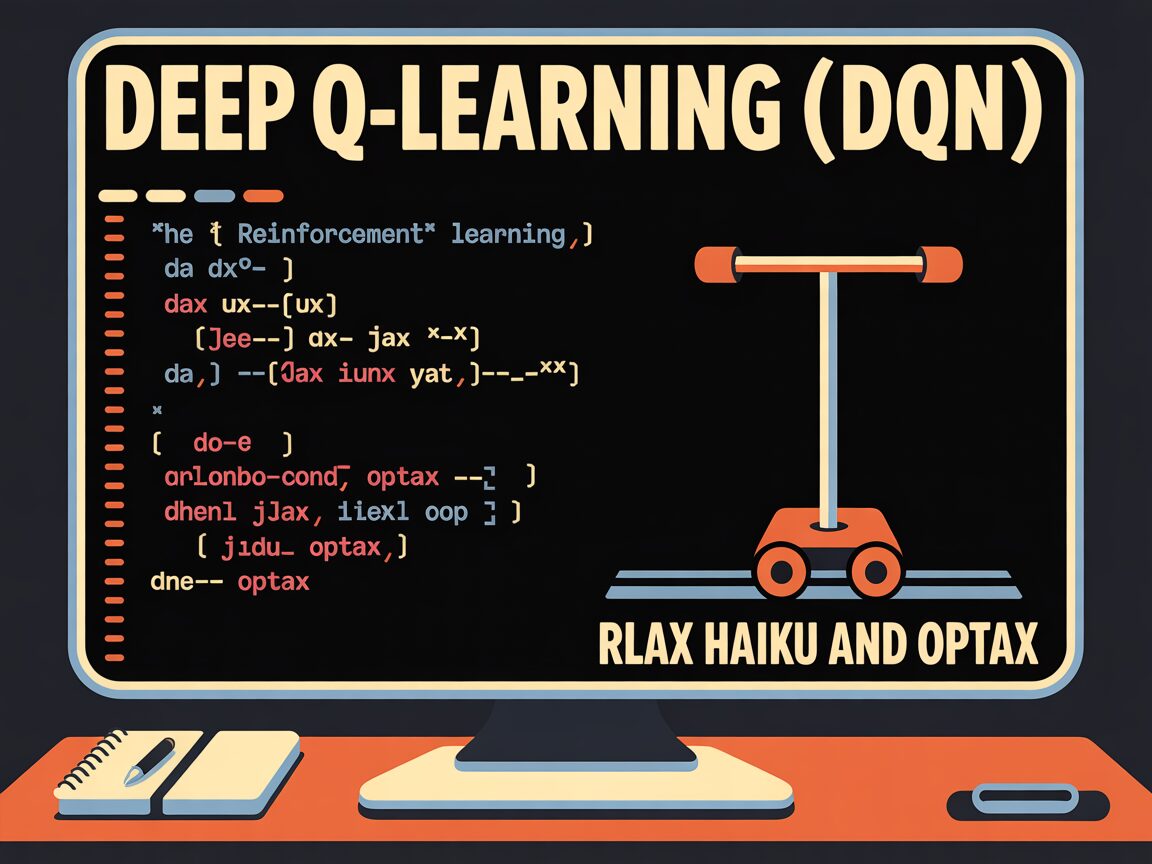
Implementing a CartPole Reinforcement Learning Agent from Scratch with RLax, JAX, Haiku, and Optax: A Deep Dive
Reinforcement learning is a crucial research area within the field of artificial intelligence. Just as a child learns about the world through trial and error, an agent interacts with an environment and learns how to maximize rewards. From complex games to self-driving cars, reinforcement learning is driving innovation across various fields. However, reinforcement learning algorithms can be complex and difficult to implement, especially when leveraging modern technology stacks such as JAX, Haiku, and Optax.
This tutorial guides you through the process of implementing a reinforcement learning agent using the RLax library, designed for novice developers. RLax is a research-oriented library developed by Google DeepMind, based on JAX, enabling efficient learning. Along with it, JAX, Haiku, and Optax are powerful tools used for fast computation, neural network modeling, and optimization, respectively. Let’s build a DQN agent and train it to solve the CartPole environment problem, understanding the core principles of reinforcement learning and learning how to utilize the latest technology stacks.
Installing Required Libraries and Importing Modules
First, we install the necessary libraries and import the modules. Use the pip install command to install RLax, JAX, Haiku, Optax, Gymnasium, Matplotlib, and NumPy. These are essential tools for building and training a reinforcement learning agent. Gymnasium, in particular, handles interaction with the environment, while Matplotlib is used for visualizing the training process.
pip -q install "jax[cpu]" dm-haiku optax rlax gymnasium matplotlib numpy
import os
os.environ["XLA_PYTHON_CLIENT_PREALLOCATE"] = "false"
import random
import time
from dataclasses import dataclass
from collections import deque
import gymnasium as gym
import haiku as hk
import jax
import jax.numpy as jnp
import matplotlib.pyplot as plt
import numpy as np
import optax
import rlax
Defining the Replay Buffer and Setting Up the Environment
We define a replay buffer to store the experiences for the reinforcement learning agent’s learning. This buffer stores the agent’s experiences (state, action, reward, next state, etc.) as it interacts with the environment. By sampling experiences randomly from the replay buffer and using them for learning, we contribute to improving the stability of the learning process. Additionally, we set up the CartPole environment and define the initial state. This environment is a simple environment with a balancing rod and a cart, where the agent learns to balance the rod by moving the cart left and right.
@dataclass
class Transition:
    obs: np.ndarray
action: int
reward: float
discount: float
next_obs: np.ndarray
done: float

class ReplayBuffer:
    def __init__(self, capacity):
        self.buffer = deque(maxlen=capacity)

    def add(self, *args):
        self.buffer.append(Transition(*args))

    def sample(self, batch_size):
        batch = random.sample(self.buffer, batch_size)
        obs = np.stack([t.obs for t in batch]).astype(np.float32)
action = np.array([t.action for t in batch], dtype=np.int32)
reward = np.array([t.reward for t in batch], dtype=np.float32)
discount = np.array([t.discount for t in batch], dtype=np.float32)
next_obs = np.stack([t.next_obs for t in batch]).astype(np.float32)
done = np.array([t.done for t in batch], dtype=np.float32)
return {
    "obs": obs,
    "action": action,
    "reward": reward,
    "discount": discount,
    "next_obs": next_obs,
    "done": done,
}

    def __len__(self):
        return len(self.buffer)

replay = ReplayBuffer(capacity=50000)
Defining the Q-Network and Optimizer
In this step, we define the Q-network and set up the optimizer. The Q-network is a neural network that predicts the future reward that can be obtained by taking a specific action in a given state. This network is built using the Haiku library and outputs the action-value function, receiving the input state. Furthermore, the Adam optimizer is used to update the parameters of the Q-network and minimize the loss function. Accurately training this Q-network is the core of reinforcement learning.
def q_network(x):
    mlp = hk.Sequential([
        hk.Linear(128), jax.nn.relu,
        hk.Linear(128), jax.nn.relu,
        hk.Linear(num_actions),
    ])
    return mlp(x)

q_net = hk.without_apply_rng(hk.transform(q_network))

dummy_obs = jnp.zeros((1, obs_dim), dtype=jnp.float32)
rng = jax.random.PRNGKey(seed)
params = q_net.init(rng, dummy_obs)
target_params = params

optimizer = optax.chain(
    optax.clip_by_global_norm(10.0),
    optax.adam(3e-4),
)
opt_state = optimizer.init(params)
Defining TD Error Calculation and Learning Step
Now, we define the core learning step of the reinforcement learning agent. This step includes calculating the Temporal Difference (TD) error using experiences sampled from the replay buffer and updating the parameters of the Q-network. The TD error represents the difference between the predicted value and the actual value, and the Q-network is trained to minimize this error in the direction of improvement. RLax provides useful tools for calculating these TD errors, allowing for efficient learning.
@jax.jit
def soft_update(target_params, online_params, tau):
    return jax.tree_util.tree_map(lambda t, s: (1.0 - tau) * t + tau * s, target_params, online_params)

def batch_td_errors(params, target_params, batch):
    q_tm1 = q_net.apply(params, batch["obs"])
q_t = q_net.apply(target_params, batch["next_obs"])
    td_errors = jax.vmap(
        lambda q1, a, r, d, q2: rlax.q_learning(q1, a, r, d, q2)
    )(q_tm1, batch["action"], batch["reward"], batch["discount"], q_t)
    return td_errors

@jax.jit
def train_step(params, target_params, opt_state, batch):
    def loss_fn(p):
        td_errors = batch_td_errors(p, target_params, batch)
        loss = jnp.mean(rlax.huber_loss(td_errors, delta=1.0))
        metrics = {
            "loss": loss,
            "td_abs_mean": jnp.mean(jnp.abs(td_errors)),
            "q_mean": jnp.mean(q_net.apply(p, batch["obs"])),
        }
        return loss, metrics

    (loss, metrics), grads = jax.value_and_grad(loss_fn, has_aux=True)(params)
    updates, opt_state = optimizer.update(grads, opt_state, params)
    params = optax.apply_updates(params, updates)
    return params, opt_state, metrics
Defining the Agent Evaluation Function
We define a function to evaluate the performance of the reinforcement learning agent. This function applies the agent to the environment, executes training for a given number of episodes, and calculates the total reward. The total reward is a measure of the agent’s performance, and the goal is to increase this value.
def evaluate_agent(params, episodes=5):
    returns = []
    for ep in range(episodes):
        obs, _ = eval_env.reset(seed=seed + 1000 + ep)
done = False
truncated = False
total_reward = 0.0
    while not (done or truncated):
        q_values = q_net.apply(params, obs[None, :])
action = int(jnp.argmax(q_values[0]))
        next_obs, reward, done, truncated, _ = eval_env.step(action)
total_reward += reward
        obs = next_obs
    returns.append(total_reward)
    return float(np.mean(returns))
Executing the Training Loop
Finally, we execute the training loop for the reinforcement learning agent. This loop repeatedly interacts with the environment, collects experiences, stores them in the replay buffer, updates the Q-network, and periodically evaluates the agent and visualizes the training process. Through this training loop, the agent learns to understand the environment and learn the optimal behavior strategy.
During the training process, an epsilon-greedy exploration strategy is used to encourage the agent to try new behaviors. Additionally, a target network is used to improve the stability of learning, and a Huber loss function is used to minimize the TD error. The reinforcement learning agent learns to balance the rod in the CartPole environment through these processes.
Future Prospects and Industry Impact
In this tutorial, we have seen the process of implementing a reinforcement learning agent using RLax. This approach can be helpful for understanding complex technologies and building customized reinforcement learning pipelines. Libraries such as RLax support researchers and developers by providing flexibility and control, enabling the development of more innovative reinforcement learning algorithms.
Reinforcement learning technology has the potential to drive innovative developments in various fields, such as self-driving cars, robotics, game AI, and financial trading. For example, self-driving cars can learn to navigate complex traffic situations safely and efficiently through reinforcement learning. Furthermore, robots can learn to perform various tasks and improve their ability to collaborate with humans through reinforcement learning. The advancement of reinforcement learning technology will open up even more possibilities in these fields.
Technical Implications
- RLax provides reusable reinforcement learning building blocks based on JAX, facilitating the construction of custom pipelines
- Haiku provides a concise and efficient interface for neural network modeling
- Optax supports easy application of various optimization algorithms
- The replay buffer improves learning stability by reusing experiences
- The epsilon-greedy exploration strategy helps find the optimal policy by attempting various behaviors
Original Source: Implementing Deep Q-Learning (DQN) from Scratch Using RLax JAX Haiku and Optax to Train a CartPole Reinforcement Learning Agent