 English
  한국어
한국어
Google DeepMind Unveils Aletheia: A Fully Autonomous AI Agent for Mathematical Research
Hello! I’m an IT specialist editor. Today, let’s talk about Google DeepMind’s latest technology, Aletheia. Have you ever heard of an AI that solves math problems? What’s special about Aletheia is that it performs mathematical research itself, going beyond simple problem-solving. It’s like a skilled researcher defining and solving problems autonomously. Until now, AI has focused on solving problems at the International Mathematical Olympiad (IMO) level, but now it can perform much more complex research.
The emergence of Aletheia not only represents a technological advancement but also suggests the possibility of transforming the future of mathematical research. Let’s explore together how AI will impact mathematical research and how collaboration with human researchers will unfold. Aletheia is showing us a new paradigm for mathematical research.
Aletheia: What Makes It Special? Let’s Quickly Cover the Essentials
- Autonomous Proof Generation, Verification, and Revision: Aletheia uses natural language processing technology to repeatedly generate, verify, and revise mathematical proofs.
- Gemini Deep Think Based: Its performance is maximized based on Gemini Deep Think, Google DeepMind’s latest AI model.
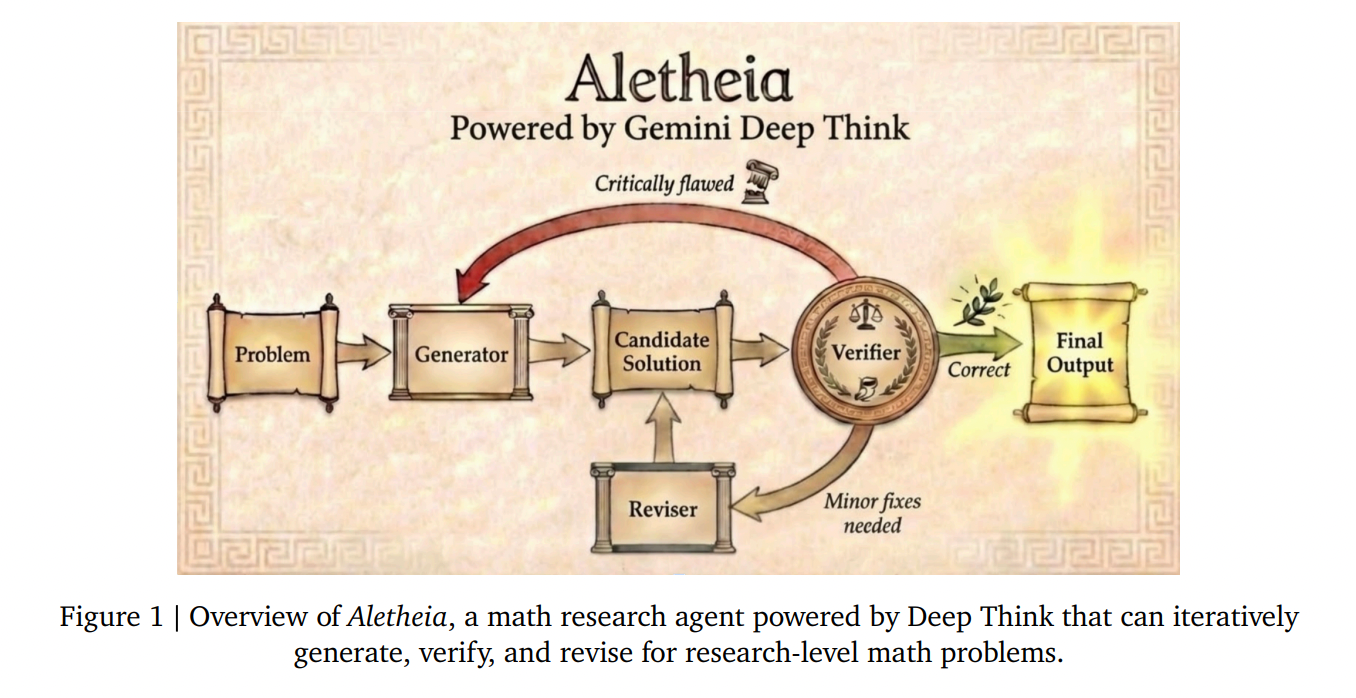
- Agentic Loop Structure: It has increased reliability through an ‘agentic loop’ consisting of three modules: Generator, Verifier, and Reviser.
- External Knowledge Utilization: It utilizes Google Search and web browsing functions to reference actual mathematical papers and prevent hallucinations.
- Proposes a New Classification System for Autonomy: It has proposed a new classification system to evaluate the contribution of AI mathematical research.
Deeper Dive: Aletheia’s Operation & Core Technologies
Agentic Loop: An Efficient Proof Process in 3 Steps
The core of Aletheia is its unique structure called the ‘Agentic Loop’. This structure consists of three main modules. The first is the Generator, which proposes potential solutions to a given research problem. However, this proposal may not be perfect. That’s where the second module, the Verifier, comes in. The Verifier uses a natural language-based informal verification mechanism to identify errors or hallucinations in the solution proposed by the Generator. Finally, the Reviser corrects the errors identified by the Verifier and repeats this process until the final result is approved. This separation of roles helps the model recognize errors that it might initially overlook. Through these three steps, Aletheia can achieve more accurate and reliable results.
Inference-Time Scaling: ‘Let It Think Longer’
We discovered an interesting fact in the research process. It turns out that providing the model with more computing resources to ‘think longer’ significantly contributes to performance improvement. Indeed, the Deep Think version from January 2026 reduced the computing resources needed to solve Olympiad-level problems by 100 times compared to the 2025 version, while significantly improving accuracy. This technology has played a crucial role in maximizing Aletheia‘s performance. It can be said to be an important discovery that allows you to balance the efficiency and accuracy of AI models.
Tool Use to Prevent Hallucinations
Even the smartest AI can sometimes generate inaccurate information, a phenomenon known as ‘hallucination’. This can be particularly problematic when referencing mathematical papers, potentially compromising the integrity of the research. To address this issue, Aletheia actively utilizes Google Search and web browsing functions. This allows it to reference actual mathematical papers and perform proofs based on accurate information. This Tool Use is an essential element in increasing Aletheia‘s reliability.
Aletheia: What Achievements Has It Shown? Key Research Milestones
- Feng26: Generation of a Fully Autonomous Research Paper: Aletheia has successfully generated a research paper on the calculation of structural constants (Feng26) without human intervention.
- LeeSeo26: Collaborative Research: Aletheia collaborated with human researchers to present a boundary proof strategy for independent sets.
- Solves Erdős Conjectures: Aletheia challenged 700 unsolved problems, finding 63 technically correct solutions and autonomously solving 4 unsolved problems.
Aletheia: How Will It Change the Future of Mathematical Research?
The emergence of Aletheia is expected to have a significant impact on the future of mathematical research. AI will assist human researchers, suggest new research ideas, and help solve complex problems. However, AI cannot solve everything. Human researchers still need to verify AI’s results and propose new research directions through creative thinking and critical judgment. Aletheia will usher in a new era of mathematical research through collaboration between human researchers and AI.
Furthermore, the emergence of Aletheia is expected to solve the data scarcity problem in the field of mathematical research and open up new research areas. For example, human researchers can solve complex mathematical problems that are difficult to access through Aletheia and develop new theories based on it. In addition, analyzing the processes solved by Aletheia can inspire human researchers and suggest new research approaches. In conclusion, Aletheia will contribute to increasing the efficiency of mathematical research and creating new knowledge.
In-Depth Analysis and Implications
Array
Original Source: Google DeepMind Introduces Aletheia: The AI Agent Moving from Math Competitions to Fully Autonomous Professional Research Discoveries