 English
  한국어
한국어
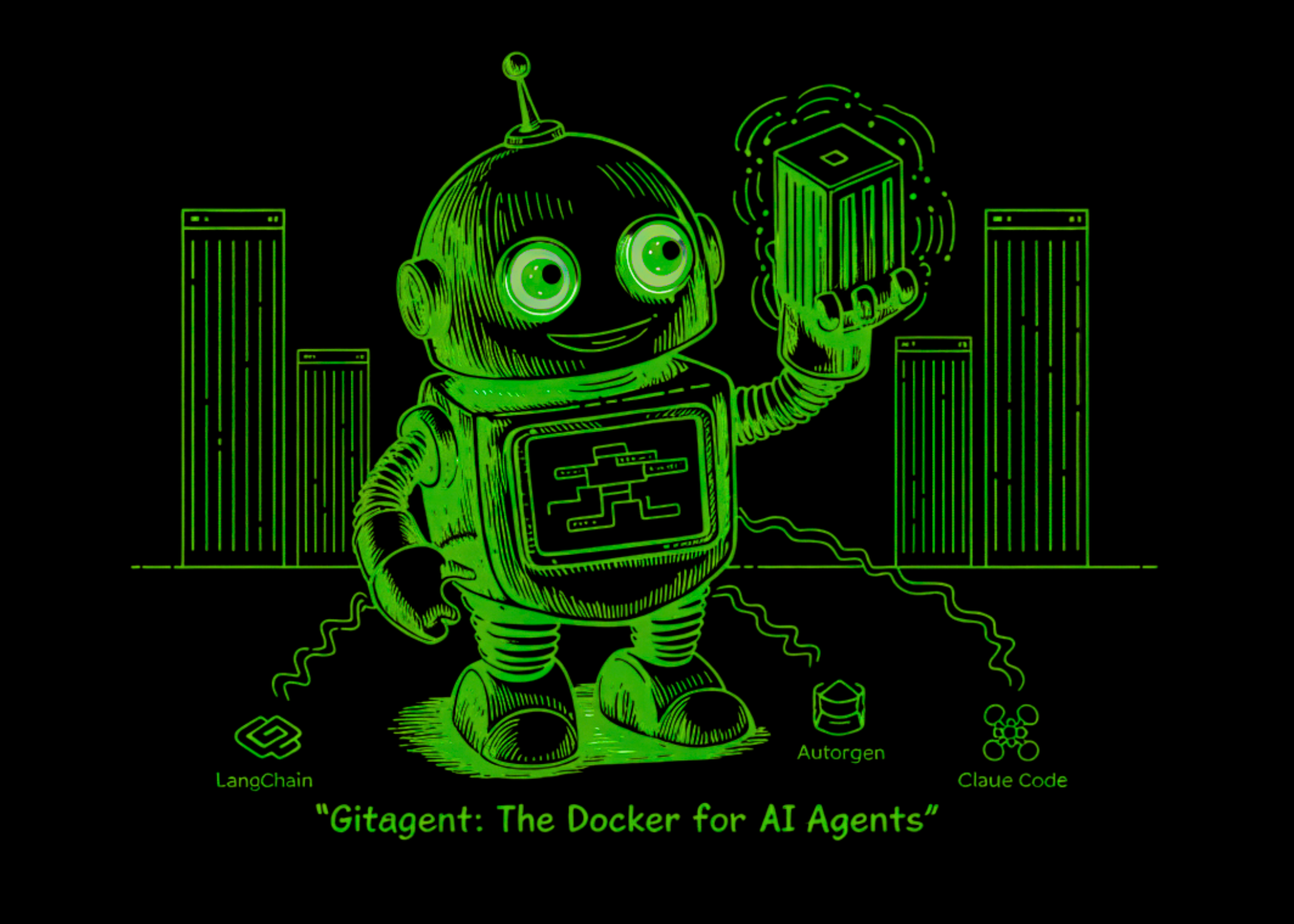
GitAgent: Docker for AI Agents Solving Fragmented Environments?
As AI technology advances, interest in AI agents that autonomously perform tasks is growing. However, the current AI agent development environment is very complex and chaotic. It’s like having various frameworks like Lego blocks, but they are not compatible, forcing developers to be dependent on a specific framework. It’s like having several architects writing instruction manuals in different ways to build a house. The basic principles of building a house are the same, but if the manuals are different, it’s difficult to build a proper house.
To solve this problem, a new solution called GitAgent has emerged. GitAgent is like a container that isolates AI agents and makes them compatible with various frameworks. It’s like standardizing Lego blocks so that anyone can easily assemble them.
Why GitAgent Emerged – Challenges in AI Agent Development
Until now, various frameworks such as LangChain, AutoGen, CrewAI, OpenAI Assistants, and Claude Code have been used for AI agent development. Each framework defines agent logic, memory, and tool execution in its own way. This heterogeneity puts a great burden on developers. It’s like having to use multiple languages as a translator. Switching between frameworks is as difficult as rewriting the entire code. This increases development time and costs, and makes maintenance difficult. It also leads to a loss of technical flexibility by being dependent on a specific framework.
GitAgent’s Core: A Universal Format Independent of Frameworks
GitAgent proposes a new approach using Git repositories to solve this problem. It manages the definition of AI agents as a structured directory within a Git repository, allowing them to run in various environments without being dependent on a specific framework. It’s like being able to create various dishes using a standardized recipe. By storing and managing AI agents within a Git repository, developers can define an agent once and easily export it to multiple frameworks.
Overview of GitAgent Components
- agent.yaml: Core manifest file containing metadata for the agent, model provider, version information, and environment dependencies. It’s like the instruction manual containing the list of ingredients and cooking method for a recipe.
- SOUL.md: Markdown file defining the agent’s core identity, personality, and tone. It replaces conventional unstructured system prompts to clearly express the agent’s personality. It’s like an introduction that captures the chef’s philosophy and the recipe’s concept.
- DUTIES.md: Specifies the responsibilities and limitations that the agent can perform. This plays an important role in clearly defining the agent’s scope of action and ensuring safety. It’s like a guide outlining hygiene rules and precautions that the chef must follow.
- skills/ and tools/: Directory containing the agent’s functional capabilities. skills means high-dimensional behavior patterns, and tools represents Python functions or API definitions for interacting with external systems. It’s like a toolbox containing various tools and techniques used by the chef.
- rules/: Space to apply agent safety and organizational constraints. This ensures that the agent operates safely in any situation. It’s like a rulebook containing safety precautions and recipes that the chef must follow.
- memory/: Unlike existing agents, it stores the agent’s state in human-readable files such as dailylog.md and context.md. This makes it easy to understand and manage the agent’s state. It’s like a recipe notebook containing records.
Monitoring and Version Management Layer: Tracking Changes in AI Agent Behavior
Tracking changes in the behavior of autonomous AI agents is an important technical challenge. GitAgent solves this problem by using Git as the main monitoring layer. It’s like a chef recording and managing the cooking process. Changes in the agent’s internal state – memory changes or acquisition of new skills – are considered as code changes. Updates to the agent’s context.md or modifications to the SOUL.md based on new learning create new Git branches and Pull Requests (PR). This allows developers to apply existing CI/CD (Continuous Integration/Continuous Delivery) practices to AI agent behavior.
Humans can review changes in the agent’s memory or personality to ensure that the agent is consistent with its original intent. If the agent exhibits hallucinatory behavior or deviates from its personality, developers can simply revert to a previous stable state using a Git revert.
Framework Interoperability and ‘Export’ Workflow: Opportunities for Free Framework Selection
A core feature of GitAgent is its CLI-based export mechanism. Once an agent is defined in a universal format, it can be ported to environments of major frameworks such as OpenAI, Claude Code, LangChain, CrewAI, and AutoGen. You can switch the execution engine without changing the basic logic of the AI agent’s SOUL.md or skills/ directory. This allows developers to choose the most suitable orchestration layer for a specific task.
Enterprise Compliance and Separation of Duties (SOD): Safe and Reliable AI Agents
For developers and AI researchers in regulated industries, GitAgent provides built-in support for compliance standards such as FINRA, SEC, and the Federal Reserve. This is achieved through a Separation of Duties (SOD) framework defined within the DUTIES.md. In many regulatory compliance requirements, the process initiator is not the same person as the approver. With GitAgent, developers can define a conflict matrix assigning roles such as maker, checker, and executor. Prior to deployment, the gitagent validate command checks these configurations to prevent a single agent from having excessive permissions that could lead to regulatory violations.
Key Summary: GitAgent’s Value
- Framework-agnostic portability: Separates AI agent logic from the execution environment.
- Git-Native Monitoring (HITL): Replaces custom approval dashboards with standard Pull Requests (PR).
- Human-readable state management: Unlike opaque vector databases, GitAgent stores long-term memory in Markdown files (context.md, dailylog.md) in the memory/ directory.
- Built-in enterprise compliance: The format includes built-in support for FINRA, SEC, and Federal Reserve regulations.
- Declarative ‘Soul’ and skills: The agent’s identity and functionality are defined in structured files such as SOUL.md (instructions/personality) and skills/ (modular functions).
So far, we have looked at how GitAgent can help solve technical impasses and offer new possibilities for AI agent development. It is expected that AI agent development will be easier, safer, and more efficient with the emergence of GitAgent.
Check out the GitAgent repository, follow on Twitter, and join the 120k+ ML subreddit and subscribe to the newsletter. You can also join us on Telegram!
Deep Dive and Implications
Array
Original Source: Meet GitAgent: The Docker for AI Agents that is Finally Solving the Fragmentation between LangChain, AutoGen, and Claude Code