
 English
  한국어
한국어
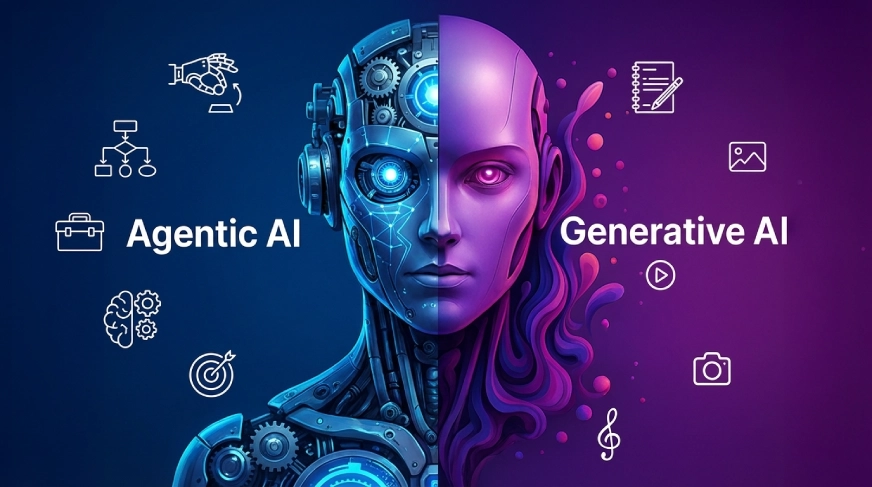
Introduction: A New Stage in AI Evolution – From Generative AI to Agent AI
Over the past two years, the term ‘Generative AI’ has become familiar to not only the technology industry but also the general public. Tools like ChatGPT, Gemini, and Claude have transformed AI from a simple technical term into a commonplace word. These tools have demonstrated innovative possibilities in various fields, such as text generation and image creation, and have significantly increased public interest in AI technology. However, we are now entering the next stage of AI evolution.
Early generative AI primarily focused on content creation. The main goal was to generate text, images, and code based on user requests. However, the focus is now shifting from AI generating content to AI actually ‘acting.’ This change signifies a paradigm shift in AI technology, not just the addition of new features. The key technology driving this change is Agent AI.
Main Body: What’s the Difference Between Generative AI and Agent AI?
To understand Generative AI and Agent AI, it’s important to clearly distinguish the characteristics of each technology. Generative AI specializes in learning data patterns and generating new content. For example, ChatGPT can answer questions or compose stories by learning vast amounts of text data. Gemini has image generation and analysis capabilities. These models are proficient in generating content based on user instructions, but their ability to set goals and execute them autonomously is limited.
In contrast, Agent AI is an autonomous system that perceives its environment, sets goals, establishes action plans to achieve those goals, executes them, and learns from the results. In other words, it goes beyond simply generating content to understand user intentions and solve problems and perform tasks independently. This Agent AI can automate complex tasks and make users’ lives more convenient by leveraging various tools and APIs. For example, Agent AI can automatically manage users’ schedules, organize emails, and handle online shopping.
Core Components of Agent AI
Agent AI isn’t simply a combination of generative AI models; it’s a complex system comprising several core components that work organically. The main components are:
- Perception: A module that collects and analyzes environmental information. It must be able to process various forms of data, such as text, images, and audio.
- Planning: A module that establishes action plans to achieve goals. It must generate optimal plans considering various constraints and uncertainties.
- Action: A module that executes actions according to the plan. It must be able to automate tasks using various tools and APIs.
- Learning: A module that learns from action results and improves future performance. Various learning methods, such as reinforcement learning and imitation learning, can be applied.
These components work together to achieve users’ goals and continuously learn and improve performance. Agent AI plays a crucial role in effectively managing this complexity and providing users with the optimal solutions.
Real-World Applications of Agent AI
Agent AI is already being utilized in various fields. It’s creating effects such as improved productivity, cost savings, and increased customer satisfaction in diverse industries like customer service, finance, healthcare, and education. For example, in the financial sector, Agent AI can manage customers’ investment portfolios, analyze risks, and suggest optimal investment strategies. In healthcare, Agent AI can analyze patient symptoms, assist with diagnosis, and develop personalized treatment plans. In education, Agent AI can assess students’ learning progress, provide customized learning materials, and motivate learning.
In-Depth Analysis: Impact on Industry and Future Prospects
Agent AI’s emergence is expected to bring revolutionary changes to various industries. As the level of automation increases, most repetitive and simple tasks can be automated, leading to improved productivity and cost savings. Furthermore, Agent AI can complement human capabilities and help solve more complex problems. For example, Agent AI can support human decision-making in areas such as data analysis, decision-making, and problem-solving, helping to produce more accurate and efficient results.
In the future, Agent AI will become even more advanced, becoming a partner that collaborates more closely with humans. Agent AI can predict users’ needs, proactively solve problems, and provide customized services. This advancement can significantly improve the user experience and open up possibilities for new business models. However, the advancement of Agent AI must also consider important issues such as ethical concerns and social responsibility. Issues such as AI bias, data privacy, and job losses must be resolved. To address these issues, technical development and ethical guidelines as well as social consensus are necessary.
Conclusion: The Era of Agent AI
Agent AI isn’t just a technological trend; it’s a crucial milestone in AI technology’s evolution. Just as generative AI revolutionized the content creation sector, Agent AI will lead to innovation in various fields, such as task automation, decision support, and personalized services. We must actively explore the potential of Agent AI and pursue sustainable development by considering ethical issues and social responsibility. Agent AI will have a profound impact on our society and economy, and proactive preparation for that change is necessary.
In-Depth Analysis and Implications
- Enhanced Autonomy: Agent AI automates tasks, including goal setting, planning, action execution, and learning, to maximize efficiency.
- API Integration: It can be flexibly utilized in actual work environments by integrating various external APIs and tools.
- Reinforcement Learning: Agent AI learns through trial and error and continuously improves performance over time.
- Ethical Considerations: Ethical considerations regarding bias, data privacy, and job losses in Agent AI are essential.
- Complexity Management: Effective management of the complexity of Agent AI systems and technological development for stable operation are important.
Original Source: Generative AI vs Agentic AI: From Creating Content to Taking Action