
 English
  한국어
한국어 日本語
日本語
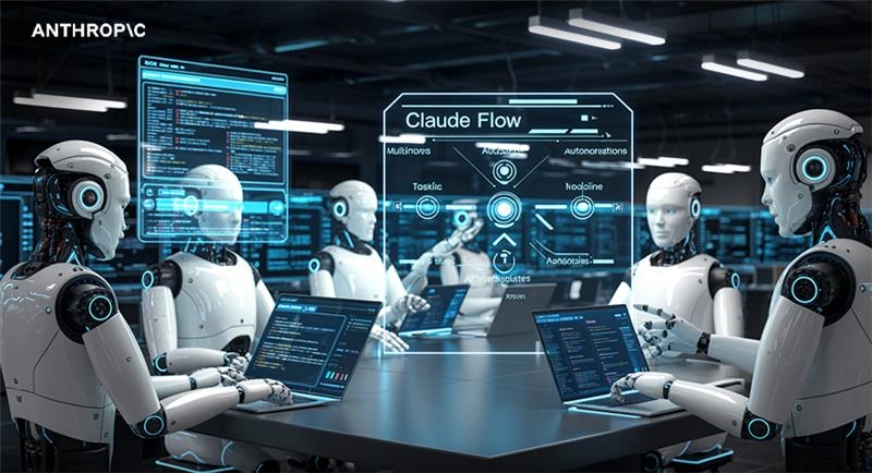
Claude Flow: An AI Orchestration Framework Redefining Multi-Agent Automation
Hello, AI developers! Have you ever encountered limitations while trying to create something amazing with Large Language Models (LLMs)? Especially when dealing with complex tasks, relying on a single model often leads to reduced quality or performance. That’s where ‘Claude Flow’ comes in.
Claude Flow is an open-source framework that acts like an orchestra conductor, helping you efficiently handle complex tasks by coordinating multiple Claude agents. While traditional approaches relied on a ‘single model,’ Claude Flow enables ‘multiple models’ to collaborate, share information, leverage their expertise, and create synergy. It’s like assembling Lego blocks – you can connect various agents with different functionalities to build the AI system you desire.
1. Why do you need Claude Flow? Limitations of Existing Methods and New Possibilities
So, why isn’t the existing single LLM prompt chain method sufficient? The answer is simple: it’s more efficient and accurate to solve complex tasks by breaking them down into multiple steps. For example, let’s consider the task of ‘planning a trip.’ It’s much better to use specialized agents like a ‘flight search agent,’ a ‘hotel booking agent,’ and a ‘tourist attraction recommendation agent’ to handle each step independently than to simply input ‘Plan a trip to Paris’ into a single prompt.
Claude Flow provides a powerful foundation for building these multi-agent systems. Each agent is optimized for a specific task, and they complete the overall workflow by sharing information and passing results to each other. This allows developers to build more complex and sophisticated AI automation systems efficiently, and the possibilities of Claude Flow are limitless.
2. Key Features of Claude Flow: Agent Collaboration and Memory Sharing
One of the biggest advantages of Claude Flow is its agent collaboration and memory sharing functionality. Just like team members share opinions, exchange information, and achieve common goals, agents in Claude Flow leverage each other’s results, share necessary information, and sequentially solve complex tasks. This collaboration maximizes the expertise of each agent and improves the overall system’s efficiency.
Furthermore, Claude Flow provides memory sharing functionality between agents, enabling them to remember results from previous steps and proceed to the next based on that information. This is particularly useful for complex decision-making processes or long-term planning. For example, when building an ‘investment strategy’ agent system, you can leverage historical investment data to formulate more accurate and effective strategies. Claude Flow helps you build more intelligent AI systems through these functionalities.
3. Claude Flow for Developers: Use Cases and Building Methods
So, how can Claude Flow be used in practice? It can be used in various fields, including AI automation, agent systems, and advanced development tools. For example, when building a customer support chatbot, you can connect a ‘question analysis agent,’ an ‘answer search agent,’ and a ‘customer satisfaction evaluation agent’ to provide more efficient and accurate responses. Additionally, you can streamline the data analysis process by utilizing a ‘data collection agent,’ a ‘data cleansing agent,’ a ‘data analysis agent,’ and a ‘reporting agent’ to automate complex data analysis tasks.
Because Claude Flow is an open-source framework, developers can freely modify and extend the code to build their own AI systems. You can learn the installation and configuration methods by referring to the official Claude Flow documentation and implement the desired functionality by connecting various agents. Claude Flow offers limitless possibilities for developers and will open a new horizon for AI development.
In-Depth Analysis and Implications
The emergence of Claude Flow is expected to bring significant changes to the AI orchestration field. It can shift from the traditional approach of relying on a single LLM model to a new paradigm that utilizes multi-agent systems. This will contribute to building more complex and sophisticated AI systems and expanding the scope of AI applications. The influence of Claude Flow is expected to be greater, especially in fields such as AI automation, agent systems, and advanced development tool construction.
In the future, AI orchestration frameworks like Claude Flow will continue to evolve, supporting developers in building AI systems more easily and efficiently. Furthermore, AI ecosystems where various agents interoperate and collaborate are expected to be established, leading to the emergence of more intelligent and innovative AI services. Claude Flow will be an important step towards this future. Claude Flow will lead future AI development trends and enrich our lives. Please pay attention to Claude Flow‘s future progress.
Deep Analysis and Implications
Array
Original Source: Claude Flow: The AI Orchestration Framework Redefining Multi-Agent Automation