 English
  한국어
한국어 日本語
日本語
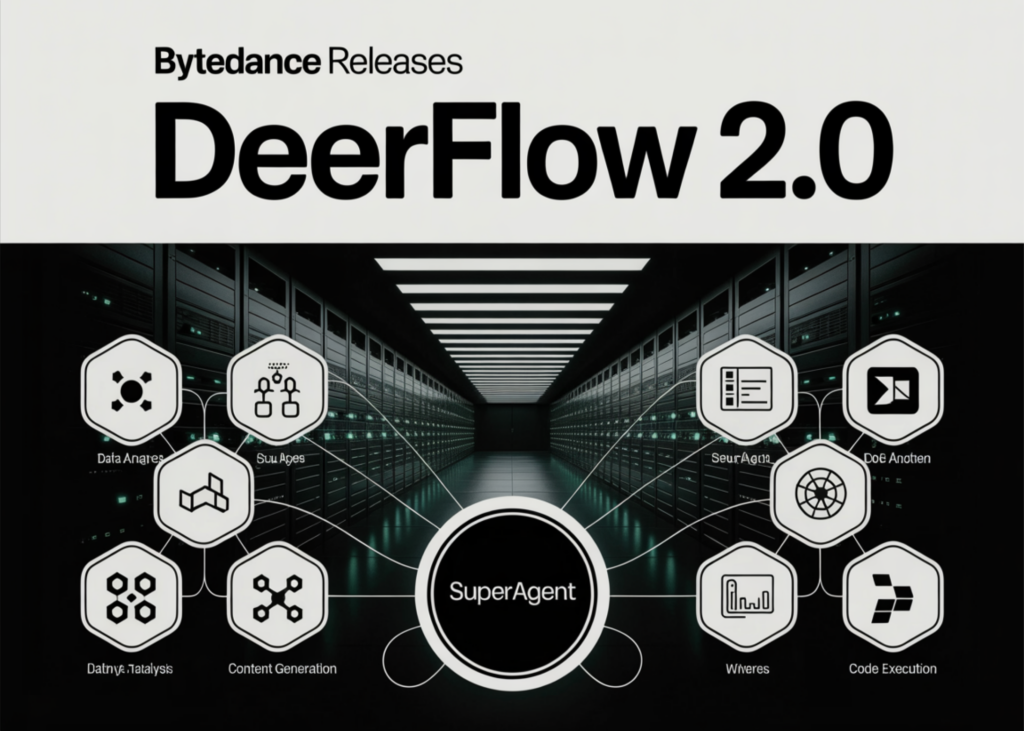
ByteDance DeerFlow 2.0: Open-Source SuperAgent Framework for Automated Task Execution
Artificial intelligence (AI) technology is rapidly evolving, revolutionizing the way we work. Early AI models primarily focused on supporting text-based tasks, such as coding suggestions or email drafts. However, ByteDance has presented a new approach that goes beyond this existing paradigm: DeerFlow 2.0. This new DeerFlow framework provides a ‘SuperAgent’ function that goes beyond simple suggestions to actually execute tasks, significantly expanding the scope of AI technology.
The ByteDance team has released DeerFlow, which can autonomously perform research, coding, website building, slide deck creation, and even video content creation. This demonstrates that AI is evolving from a simple tool to a partner actively solving problems and creating value. The unique execution method of DeerFlow particularly overcomes the limitations of existing AI agents and opens up new possibilities.
AI’s Sandbox: An Innovation in Execution Environment
Traditional AI agents typically operate within a text box interface, sending queries to APIs and returning text results. In other words, the code generated by AI had to be copied, pasted, and debugged by the user. This caused considerable inconvenience and was a factor hindering the efficiency of AI utilization.
DeerFlow has introduced an innovative approach to solve this inconvenience. This framework operates within a real, isolated Docker container, providing AI with actual file system, bash terminal, file read, and write capabilities. This holds immense significance for developers. Now, rather than simply ‘spouting’ the code it has executed, DeerFlow is an agent that actually executes and provides the results of the code. For example, if it receives a request to generate a Python script for analyzing a CSV file, DeerFlow sets up the environment, installs dependencies, executes the code, and delivers the resulting chart to the user.
Multi-Agent Orchestration: Divide, Conquer, and Integrate
A core feature of DeerFlow is its multi-agent orchestration technology. This framework utilizes a lead agent called ‘SuperAgent’ to perform project management functions. When receiving complex prompts, DeerFlow breaks them down into multiple logical subtasks. For example, if it receives a request such as ‘Research the top 10 AI startups of 2026 and create a comprehensive presentation,’ it creates individual agents responsible for each subtask, such as web scraping, competitor analysis, and image generation, and processes them in parallel. Each agent performs tasks in an independent sandbox, and the results are integrated back into the lead agent to create the final output, such as a slide deck or web application. This parallel processing allows tasks that would traditionally take humans hours to analyze to be completed in a much shorter time.
From Research Tool to Full-Stack Automation: The Evolution of DeerFlow
Interestingly, DeerFlow was not originally designed to provide a wide range of features. ByteDance initially developed this framework as a specialized research tool. However, as the internal community utilized DeerFlow‘s functions, the functionality was expanded in various ways. Users leveraged DeerFlow‘s Docker-based execution capabilities to build automated data pipelines, create real-time dashboards, and even build web applications from scratch. Responding to these user needs, ByteDance has reworked DeerFlow and reborn it as version 2.0. As a result, DeerFlow has evolved from a simple research tool to a general-purpose framework encompassing a variety of functions such as deep web search, content creation, code execution, and asset generation.
Impact and Future Prospects for the Industry
The emergence of DeerFlow is expected to have a significant impact on the AI development field. Developers will no longer need to spend a lot of time writing and debugging code directly, but instead can focus on higher-level problem-solving and strategic work. Furthermore, DeerFlow is expected to lower the barrier to entry for AI development, allowing more people to utilize AI technology and accelerate AI-based innovation. In the future, SuperAgent frameworks like DeerFlow are likely to continue to evolve, potentially transforming our way of working completely. AI will become a core partner, expanding our abilities and increasing productivity, rather than a simple tool.
However, the emergence of powerful AI frameworks like DeerFlow can also raise ethical issues. Preparations are needed to address potential malfunctions or misuse that could arise from AI autonomously performing tasks, and it is also important to establish a clear accountability for AI. The successful utilization of DeerFlow requires a balanced approach that considers not only technological advancements but also social responsibility and ethical considerations.
Key Technology Implications
- Independent Execution Sandbox: Unlike traditional AI agents, DeerFlow operates within an isolated Docker-based sandbox, enabling code execution and command execution.
- Hierarchical Multi-Agent Orchestration: Maximizes efficiency by breaking down complex tasks into subtasks and processing them in parallel.
- SuperAgent Transition: Completely redesigned from a specialized research tool to a framework capable of processing universal tasks.
- Complete Model Independence: Compatible with various LLMs, such as GPT-4, Claude 3.5, and Gemini 1.5.
- State Information Retention and Persistence: Functions as a long-term AI partner by remembering user preferences, writing styles, and project contexts.
For more details on DeerFlow, you can check the GitHub Repo. You can also stay up-to-date with the latest information by following Twitter and subscribing to the newsletter. You can also participate on Telegram.
In-Depth Analysis and Implications
Array
Original Source: ByteDance Releases DeerFlow 2.0: An Open-Source SuperAgent Harness that Orchestrates Sub-Agents, Memory, and Sandboxes to do Complex Tasks