 English
  한국어
한국어 日本語
日本語
LLM Reasoning Limitations: Why Even State-of-the-Art Models Struggle?
Recent advancements in large language models (LLMs) like ChatGPT, Gemini, and Claude are remarkable. They perform various tasks, from coding and translation to text summarization, showcasing abilities similar to humans. However, ‘reasoning,’ a core capability of LLMs, remains deficient. In particular, the ability to update beliefs based on new evidence, known as ‘probabilistic reasoning,’ is significantly lacking. This is akin to a skilled flight booking assistant being unable to learn from user preferences after the initial request.
Recent research from Google’s research team highlights this issue, revealing that current LLMs don’t fully understand the complexities of the real world. Even the latest models like Llama-3-70B and Qwen-2.5-32B have demonstrated a stagnation of learning ability after initial interactions. This means LLMs excel at memorizing text data and recognizing patterns, but lack the ability to understand real-world uncertainty and make judgments accordingly.
Bayesian Teaching: A New Approach to Teaching LLMs ‘Educated Guesses’
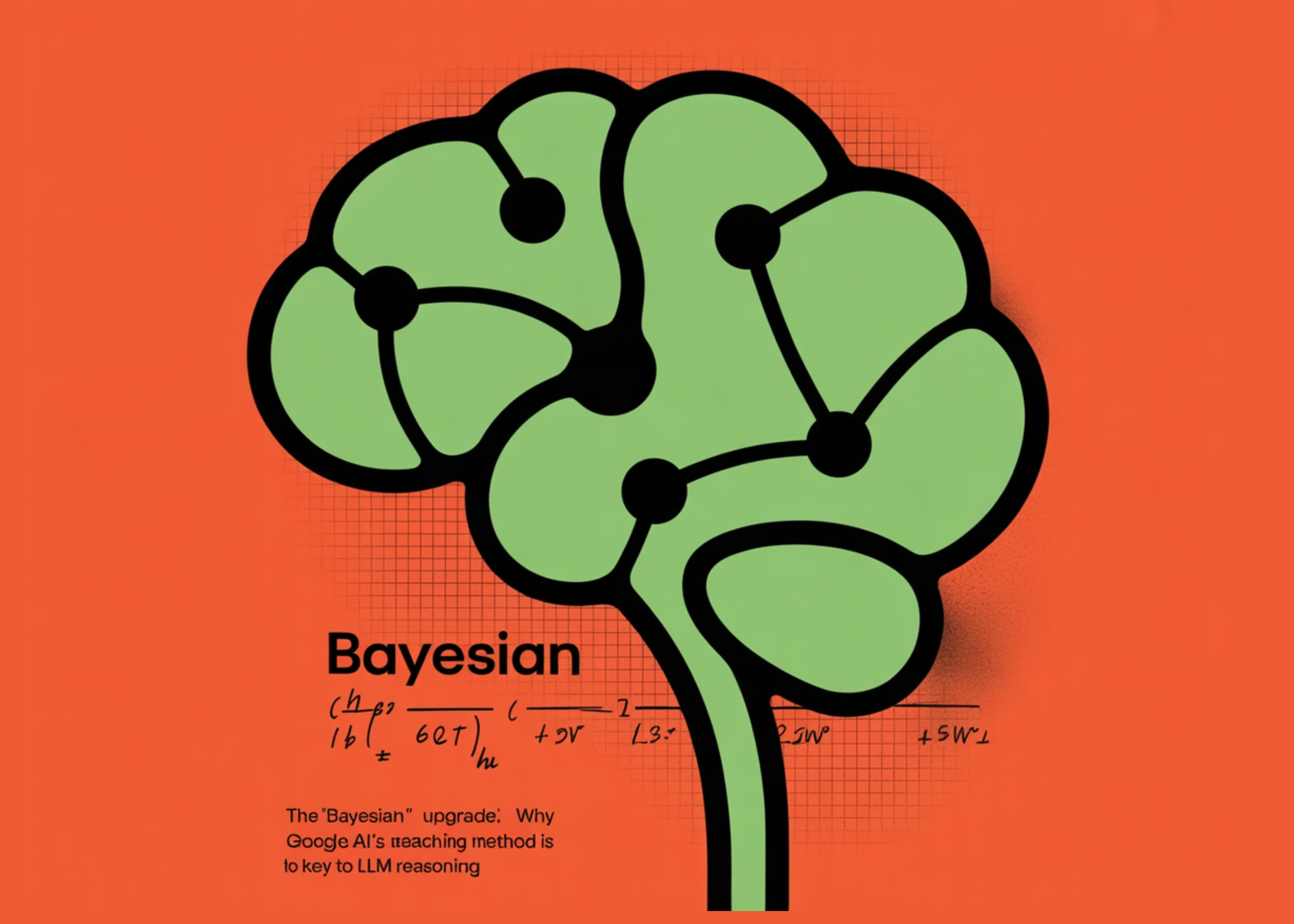
The traditional approach to LLM training focuses on providing ‘correct answers.’ This is like rote memorization for students. However, Google’s research team proposes a new method called ‘Bayesian teaching,’ which focuses on teaching LLMs to make ‘educated guesses’ rather than simply providing the correct answers. Bayesian teaching trains LLMs to mimic the reasoning process of a Bayesian assistant that estimates user preferences.
In a Bayesian assistant, prior information and new evidence are combined to update a probability distribution over user preferences. This allows LLMs to not only memorize answers but also develop the ability to understand and reason through uncertainty. This is analogous to a mathematician formulating multiple hypotheses and refining them based on experimental results.
Bayesian teaching is implemented through Supervised Fine-Tuning (SFT). SFT trains the model using interaction data between a Bayesian assistant and the LLM in addition to the existing data. This enables the LLM to mimic the reasoning process of the Bayesian assistant and develop the ability to make rational judgments within uncertainty.
‘Educated Guesses’ Over Correct Answers: Why Bayesian Teaching is More Effective
Surprisingly, Bayesian teaching has demonstrated superior performance compared to traditional answer-data-based learning (Oracle Teaching). Oracle Teaching trains LLMs based on a model that provides perfectly correct answers. However, Oracle Teaching has the drawback of not accurately reflecting users’ actual preferences. In contrast, Bayesian teaching allows models to make mistakes initially but learn and improve through those mistakes. This is like a child learning to avoid falls by falling and getting back up.
Models trained with Bayesian teaching (e.g., Gemma-2-9B, Llama-3-8B) have shown significantly higher accuracy and a reasoning style similar to Bayesian strategies in 80% of cases. This indicates that LLMs can not only memorize answers but also understand and apply reasoning processes. This result offers new possibilities for improving LLM reasoning abilities and lays the groundwork for expanding the scope of LLM applications.
Expansion to Various Fields: Generalization of LLM Reasoning
Google’s research team conducted experiments to verify whether LLM reasoning abilities are limited to specific fields (e.g., flight recommendations) or can be generalized to other fields. Applying the data to other areas, such as hotel recommendations and web shopping, showed that models trained with Bayesian teaching surprisingly outperformed previous models. In web shopping tasks, they even outperformed human participants. This shows that LLMs can understand reasoning processes and apply them to various situations.
This generalization ability demonstrates the potential for LLMs to function not merely as data processing tools but as partners collaborating with humans to solve complex problems. LLMs are expected to play a role in supplementing human intelligence and supporting better decision-making in various fields such as web search, product recommendations, and customer service.
Technical Implications and Future Outlook
This research demonstrates an important possibility of fusion between symbolic models and deep learning models. Symbolic models operate based on clear rules and logic, but struggle to solve complex and changing problems in the real world. Deep learning models are excellent at learning patterns and making predictions from massive data, but sometimes act like a ‘black box,’ making their reasoning processes difficult to understand. Bayesian teaching opens up the possibility of creating more powerful and explainable AI systems by merging the reasoning capabilities of symbolic models with those of deep learning models. Improving LLM reasoning abilities will be a key challenge in AI technology development and is expected to contribute to creating innovative services in various fields.
Key Technical Implications
- LLMs lack probabilistic reasoning abilities, which limits their interactive capabilities.
- Bayesian teaching improves reasoning abilities by teaching LLMs ‘educated guesses.’
- LLM reasoning abilities can be generalized to various fields and applied to complex tasks such as web shopping.
- LLMs are more robust to errors caused by human bias or carelessness.
- Effective fusion of symbolic reasoning strategies into LLMs enables the construction of more powerful and explainable AI systems.
Conclusion: The Future of LLM Reasoning is ‘Bayesian’
Google’s Bayesian teaching method will be a pivotal turning point for improving LLM reasoning capabilities. This goes beyond simple technical improvements and provides the fundamental ability for AI to collaborate more effectively with humans and solve complex problems. Improving LLM reasoning abilities will be a key challenge in AI technology development and is expected to contribute to creating innovative services in various fields. More research and development will be needed to further develop LLM reasoning abilities and ensure that AI positively impacts human life.</li
In-depth Analysis and Implications
Array
Original Source: The ‘Bayesian’ Upgrade: Why Google AI’s New Teaching Method is the Key to LLM Reasoning