 English
  한국어
한국어 日本語
日本語
Coding Agents Can’t Survive Without the Latest API Documentation! Introducing Context Hub!
As AI agents become increasingly advanced, maximizing their performance has become an equally important task. However, even the most outstanding AI models struggle to perform at their best without proper documentation. It’s like having a stunning sports car but with a navigation system from 20 years ago.
To address this issue, Andrew Ng and the DeepLearning.AI team have released an open-source tool called Context Hub. Context Hub bridges the gap between an agent’s static training data and the rapidly changing modern API landscape. Now, coding agents can base their coding on the latest information!
Why Do We Need Context Hub?
Have you heard of Agent Drift? LLMs (Large Language Models) stop evolving the moment training is complete. While Retrieval-Augmented Generation (RAG) allows for personalized data usage, the ‘public’ documents that LLMs rely on are often a mess. A jumble of outdated blog posts, legacy SDK examples, and defunct Stack Overflow threads can confuse agents. It’s like a treasure hunt!
For example, let’s say you instruct an agent to implement a feature using OpenAI’s GPT-5.2. Even though the latest Responses API has become the industry standard, the agent might stubbornly insist on using the Chat Completions API, relying on its training data. This can lead to code errors, unnecessary token consumption, and hours of manual debugging. Context Hub steps in at these moments, enabling the agent to code based on the latest information.
How Does Context Hub Work?
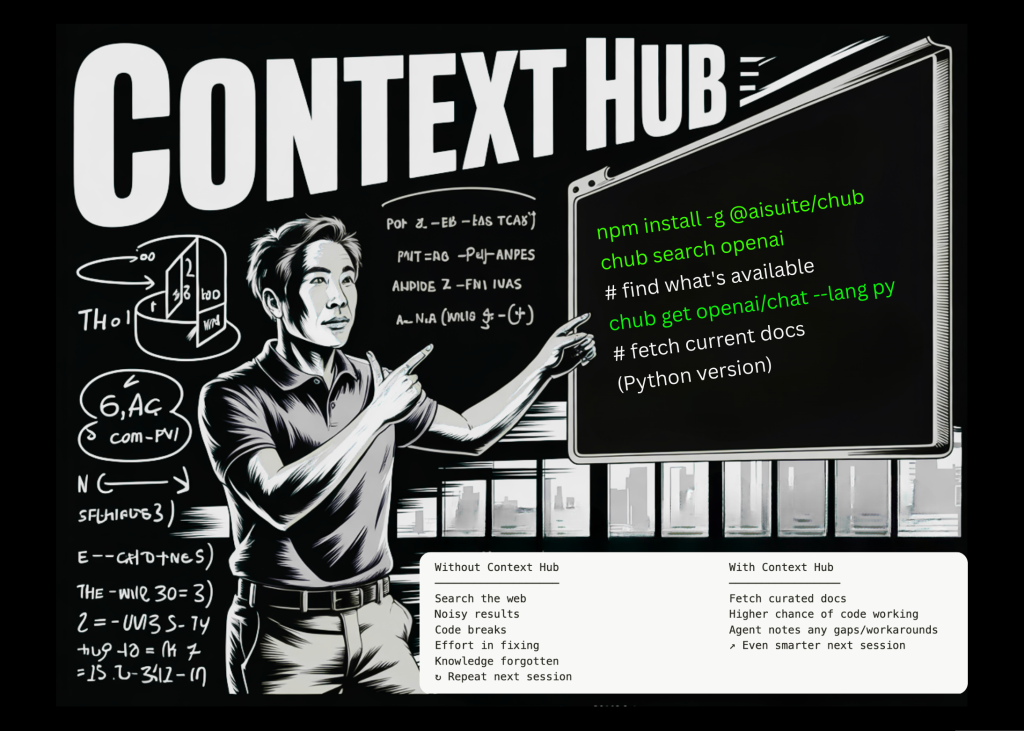
The core of Context Hub is a lightweight CLI (Command Line Interface) tool called chub. Chub is a curated document registry with the latest version, provided in a format that LLMs can easily consume. Instead of agents sifting through chaotic HTML on the web, they can retrieve precise Markdown documents through chub. Usage is simple: install Context Hub and instruct the agent to use chub.
What Can Chub Do?
- chub search: You can find specific APIs or technologies you need. Like a compass for hidden treasures.
- chub get: Retrieves curated documents. Supports language variations (e.g., –lang py or –lang js) to minimize unnecessary token consumption.
- chub annotate: One of the most compelling features, allowing agents to ‘remember’ technical challenges.
Improving Agent Memory: Annotation and Workaround
Previously, if an agent discovered a workaround for a bug in a particular library, that knowledge vanished when the session ended. Context Hub supports saving specific technical workarounds or notes to a local document registry using the chub annotate command. For example, if you discover that a webhook verification requires a raw body that cannot be parsed, you can execute the following command:
chub annotate stripe/api "Needs raw body for webhook verification"
In subsequent sessions, when the agent executes the chub get stripe/api command, that note is automatically added to the document. This provides coding agents with a ‘long-term memory’ for technical nuances, preventing them from repeatedly solving the same problems every morning. Thanks to Context Hub, agents no longer need to go through the same trial and error process every day!
Crowdsourcing ‘Truth’
Annotations are stored locally on developers’ machines, but Context Hub introduces a feedback loop that benefits the entire community. Using the chub feedback command, agents can upvote or downvote the accuracy of documents and apply specific labels such as accuracy, outdated, or incorrect examples.
This feedback is passed on to the maintainers of the Context Hub registry. Over time, the most reliable documents are promoted, and outdated items are flagged for community updates. This is a decentralized approach to maintaining documentation, which evolves as quickly as code. Context Hub is the process of creating ‘truth’ for us all!
Why is Context Hub Important?
- Solves Agent Drift: Addresses the issue of AI agents relying on static training data and using outdated APIs or hallucinating nonexistent parameters (Agent Drift).
- CLI-Based Ground Truth: Provides agents with curated, LLM-optimized Markdown documents that they can immediately retrieve using the chub CLI, enabling them to build using the latest standards (e.g., the latest OpenAI Responses API instead of the Chat Completions API).
- Persistent Agent Memory: The chub annotate feature allows agents to save specific technical workarounds or notes to a local registry, preventing them from ‘rediscovering’ the same solution in future sessions.
- Collaborative Intelligence: Using chub feedback, agents can vote on the accuracy of documents, creating a crowdsourced ‘ground truth’ that promotes the most reliable and up-to-date resources for the entire developer community.
- Language-Specific Precision: The tool minimizes token waste by allowing agents to request documents using a specific language as needed (e.g., using the –lang py or –lang js flag).
Context Hub is expected to significantly contribute to improving the performance of coding agents and increasing developer productivity. Now that agents can access the latest information and code better, thanks to Context Hub!
GitHub Repo. Also, follow us on Twitter and join our ML subreddit with over 12 million members and subscribe to our newsletter. Oh, have you joined Telegram yet? You can now join us on Telegram as well.
In-depth Analysis and Implications
Array
Original Source: Andrew Ng’s Team Releases Context Hub: An Open Source Tool that Gives Your Coding Agent the Up-to-Date API Documentation It Needs