
 English
  한국어
한국어
AI and Generative AI: What’s the Difference?
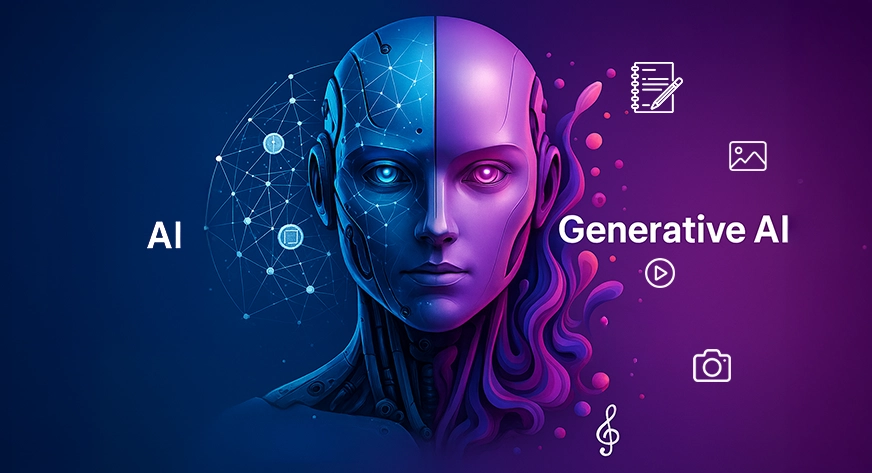
Thanks to ChatGPT, Gemini, and Claude, AI has become a part of our daily conversations. Along with this has come the unfamiliar term ‘Generative AI.’ While these terms are often used interchangeably, they are not exactly the same concept. Generative AI isn’t a replacement for AI; rather, it’s a part of the larger picture. Understanding this difference is crucial for a deeper understanding of the current and future state of AI technology. It’s like pizza and toppings – AI is the pizza, and generative AI is the delicious topping.
AI (Artificial Intelligence) is a broad term encompassing technology designed to solve problems and make decisions by mimicking human intelligence. Examples of AI technology include chatbots, recommendation systems, and self-driving cars. In contrast, Generative AI is a specific field of AI specializing in generating new content based on given data. It can create various forms of content, such as text, images, audio, and video. This is the biggest difference between AI and Generative AI.
How Does Generative AI Work?
Generative AI operates based on deep learning technology, specifically Large Language Models (LLMs). LLMs learn from vast amounts of data, identify patterns, and generate new content based on those patterns. For example, ChatGPT learns from text data to answer questions, write emails, or generate code. Image generation AIs like DALL-E 2 and Midjourney learn from image data and generate images based on text descriptions. These models essentially operate on a principle of ‘pattern recognition,’ creating new content based on learned patterns. It’s similar to a skilled painter developing their own style by observing numerous works of art.
Generative AI models can be broadly categorized as follows:
- Text Generation Models: ChatGPT, Bard, Claude, etc. Create text-based content.
- Image Generation Models: DALL-E 2, Midjourney, Stable Diffusion, etc. Create image-based content.
- Audio Generation Models: Jukebox, Riffusion, etc. Create music and audio-based content.
- Video Generation Models: Make-A-Video, Phenaki, etc. Create video-based content.
Generative AI Applications: How Far Have We Come?
Generative AI is already being used in various fields, and its potential is limitless. Let’s look at some representative use cases:
- Content Creation: Generate various forms of content, such as blog posts, social media content, and marketing materials, to increase productivity.
- Design: Perform various design tasks, such as logos, website designs, and product designs, to implement creative ideas.
- Software Development: Streamline the software development process by generating code, fixing bugs, and automating testing.
- Customer Service: Provide 24/7 customer service through chatbots and increase customer satisfaction.
- Education: Generate customized learning materials and improve students’ learning experiences.
For example, a copywriter can use Generative AI to quickly generate various advertising slogans and select the most effective ones. In addition, game developers can use Generative AI to create dialogue for game characters or design game levels. In the medical field, Generative AI can be used to analyze patient data and develop customized treatment plans.
The Future of AI and Generative AI: Where Are We Headed?
Generative AI is expected to continue to evolve, revolutionizing our lives and work. As it becomes capable of generating more sophisticated and creative content, we will be able to explore new possibilities that were previously unimaginable. For example, we can create personalized entertainment content or provide realistic experiences in virtual worlds. However, it is also important to consider ethical issues and social impacts. Solutions must be sought for various problems, such as copyright issues of generated content, prevention of the spread of fake information, and job losses. Just like advanced technology, Generative AI requires responsible development and use to create a positive future.
Furthermore, the advancement of Generative AI will provide new opportunities for professionals in various fields. The demand for talent in Generative AI-related fields, such as data scientists, AI engineers, and ethics experts, is expected to increase. It is now more important than ever to understand and utilize the potential of Generative AI, not just as a tool.
In-Depth Analysis and Implications
- LLM (Large Language Model) based architecture: The core of Generative AI lies in the ability to recognize patterns and generate content based on patterns learned through vast data learning.
- Text-to-Image technology: The technology of generating images based on text descriptions is bringing innovative changes to the design and content creation fields.
- Ethical considerations: Ethical issues such as bias in generative AI models, copyright issues, and the spread of fake information require continuous attention and resolution efforts.
- Data bias problem resolution: Generative AI models can reflect biases in the training data, so it is important to secure data diversity and develop bias mitigation techniques.
- Emergence of Multimodal AI: Multimodal AI technology that integrates various data such as text, images, and audio to create richer and more realistic content is gaining attention.
Original Source: AI vs Generative AI: Key Differences, Models, and Real-World Uses