
 English
  한국어
한국어
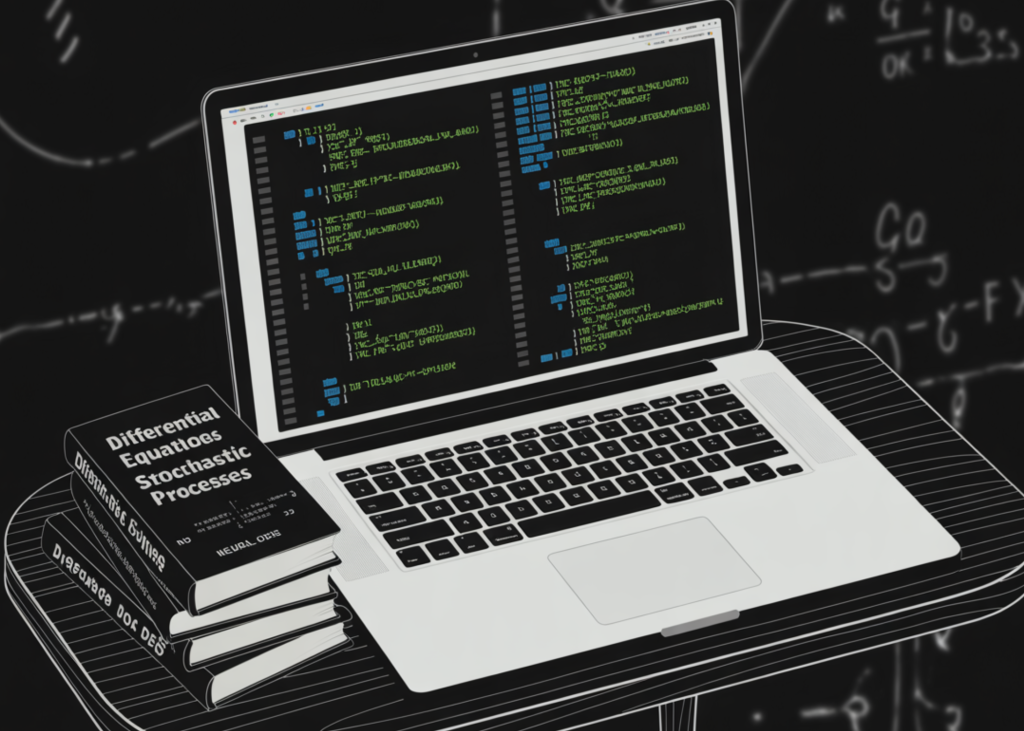
Mastering Differential Equations with Diffrax and JAX: A Guide
The importance of differential equation solutions is increasingly growing in the fields of scientific computing and machine learning. In this article, we explore how to leverage Diffrax, a powerful tool for differential equation solvers, stochastic simulations, and neural ODE (Neural Ordinary Differential Equation) implementations, along with the JAX ecosystem. Prepare to easily implement complex simulations and build differential equation-based models with all the essentials!
Diffrax is a JAX-based differential equation solver that offers fast speed and flexibility. JAX is a powerful numerical computation library that supports automatic differentiation and JIT compilation, allowing for efficient simulations when used with Diffrax. This guide will be helpful for everyone from beginners to experts in understanding and utilizing differential equation solvers.
Key Content Summary
- Installation and environment setup of the Diffrax library
- Solving differential equations using adaptive solvers
- Modeling complex systems utilizing PyTree-based states
- Batch simulations using JAX vectorization
- Data generation and model construction for training neural ODE models
1. Diffrax and JAX Environment Setup
Before starting, you need to set up the environment for the differential equation solver. Install the necessary libraries such as Diffrax, JAX, Equinox, and Optax, and set up the JAX backend to enable JIT compilation. This process optimizes the performance of differential equation simulations.
Since Diffrax is JAX-based, setting up the JAX environment is crucial. JAX can utilize GPUs or TPUs to accelerate calculations, allowing for faster execution of complex differential equation simulations. If errors occur during the environment setup process, refer to the official documentation or online communities for assistance.
2. Solving Differential Equations Using Adaptive Solvers
Diffrax provides various adaptive solvers to solve differential equations. Select different solvers such as Tsit5 and Dopri5 to find the most suitable solution for a specific problem. Adaptive solvers consider the accuracy and computational cost of the solution in a balanced manner for efficient computation. Additionally, Dense interpolation can be used to estimate the solution at a specific time.
For example, you can solve the logistic growth model and the Lotka-Volterra predator-prey model. The logistic growth model represents changes in population size, and the Lotka-Volterra model simulates the interaction between predators and prey. These models demonstrate the various possibilities of differential equations and can be applied to real-world problems.
3. System Modeling Using PyTree-Based States
Diffrax supports PyTree-based states, enabling the modeling of complex systems. PyTree represents a nested data structure, allowing for efficient management of system states. For example, you can model a spring-mass-damper system to simulate complex mechanical systems.
Using PyTree-based states allows you to group and manage various state variables of the system into a single structure, improving code readability and reducing the likelihood of errors. Furthermore, PyTree supports JAX’s automatic differentiation feature, making it useful for optimizing the parameters of complex systems.
4. Batch Simulations Using JAX Vectorization
Using JAX’s vectorization feature allows you to solve multiple differential equations simultaneously. This reduces simulation time and allows for efficient analysis. For example, you can simulate multiple oscillators simultaneously to compare system performance.
Batch simulations are useful for analyzing large systems or comparing multiple scenarios. JAX vectorization helps reduce code complexity and optimize performance. Additionally, using JAX’s JIT compilation feature can further enhance the speed of batch simulations.
5. Training Neural ODE Models
Diffrax can also be used to train neural ODE models, in addition to differential equation solvers. A neural ODE is a method of modeling and learning system dynamics based on differential equations. Diffrax makes it easy to build and train neural ODE models.
Neural ODEs are useful for modeling and predicting the dynamics of complex systems. For example, you can train a neural ODE model based on real-world data to predict the future state of the system. Neural ODEs can also be used to approximate solutions to differential equations.
Future Prospects
Diffrax and JAX are expected to play an increasingly important role in the fields of scientific computing and machine learning. Differential equation-based modeling will be utilized in various fields, and Diffrax and JAX will provide powerful tools for such modeling. Additionally, JAX’s automatic differentiation and JIT compilation features will contribute to improving the performance of complex simulations.
Diffrax is expected to support even more diverse solvers and features in the future, and JAX will support faster calculations utilizing GPUs and TPUs. These advancements will open up new possibilities in scientific research and engineering. Learn and utilize differential equations to create innovative solutions!
In-Depth Analysis and Implications
- JAX and Diffrax Environment Setup: Correctly set up the JAX backend to enable JIT compilation and use Diffrax to implement differential equation solvers.
- Adaptive Solver Utilization: Select various adaptive solvers such as Tsit5 and Dopri5 to optimize the accuracy and efficiency of differential equations.
- PyTree-Based State Modeling: Utilize PyTree-based states to efficiently manage system states and model complex dynamics.
- Batch Simulations via JAX Vectorization: Solve multiple differential equations simultaneously to reduce simulation time and increase efficiency.
- Neural ODE Model Training: Build and train neural models based on differential equations using Diffrax to predict system dynamics.